Seagate says AI storage demand has nearline drives booked into 2028
Seagate said cloud AI workloads are driving hard-drive capacity demand, lifting annual revenue to $12.2 billion.
By Dominic Okoye · Staff Writer
· 3 min read
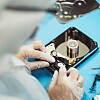
Seagate AI storage demand is pushing cloud customers to reserve high-capacity hard drives years ahead, the company told analysts after reporting a 50% year-over-year jump in fourth-quarter revenue to $3.6 billion. For the full fiscal year, Seagate said revenue rose 34% to $12.2 billion, up from $9.1 billion, as datacenter buyers absorbed more nearline capacity.
Chairman and CEO Dave Mosley said datacenter customers now account for about 90% of Seagate's exabyte shipments. Based on long-term supply agreements already signed, he said most of the company's nearline exabytes are allocated into calendar 2028. Seagate had said in February that nearline production capacity for this year was fully committed and that it had started taking orders for 2027.
Mosley told analysts the company is not seeing customers shorten their planning windows, a signal that hyperscalers are still trying to lock in hard-drive supply well before deployment. Seagate did not disclose unit commitments by customer, pricing terms for the long-term agreements, or how much of the backlog is tied directly to AI workloads rather than broader cloud storage growth.
Why is AI increasing hard drive demand?
Seagate's argument is that AI systems are generating and keeping more data as usage shifts from model training to inference and agent-style applications. Mosley said those workloads retain information for historical context, compliance and later reuse, which increases demand for lower-cost persistent storage in large datacenters.
The company is tying that demand to tiered storage architectures, where cloud operators use memory and SSDs for performance and hard drives for large-scale capacity. Mosley cited a Seagate white paper with SK hynix that discusses inference and agentic AI workloads using key-value, or KV, cache to preserve context across interactions.
According to Seagate, spreading KV cache data across memory, SSD and hard-drive tiers can let customers keep more context while reducing recomputation of previously generated data. The company claims that would cut some GPU work spent recreating old context and leave more compute for paid workloads. That claim is useful to Seagate's sales case, but the company did not provide customer deployment data or independent performance results on the analyst call.
Hard drives remain Seagate's main growth engine
Seagate's exposure to this cycle is concentrated in hard drives, particularly nearline products sold to hyperscalers and large enterprises. CFO Gianluca Romano said recent capacity growth has come largely from drives with more disks and heads rather than from higher unit shipments.
Romano said the number of disks and heads inside Seagate drives likely grew between 15% and 20% over the past year, while units were flat. He described that as a normal part of the business. The distinction matters for investors and customers because Seagate can grow shipped exabytes without expanding unit volumes at the same pace.
For the current quarter, Seagate projected revenue of $4.1 billion, plus or minus $100 million. The company said that would represent 56% year-over-year growth if achieved.
On the product side, Seagate said it is increasing production of its Mozaic 4 platform for major cloud providers. The platform supports drives up to 44 TB. Seagate also said Mozaic 5 remains on schedule for qualification shipments in late 2027 and is expected to exceed 5 TB per platter.
The readout gives Seagate a clear AI infrastructure story without changing the basic mechanics of its business: cloud operators need cheaper bulk capacity, and Seagate is selling more exabytes per drive into that demand. The open question is how much of the long-term reservation activity reflects durable AI storage requirements versus hyperscaler attempts to secure supply in a tight nearline market.
This story draws on original reporting from The Register.