OpenAI publisher deals linked to higher ChatGPT citations in vendor study
Press Ranger and OtterlyAI report a 48% ChatGPT citation gap, though their observational data does not establish that licensing caused it.
By Renata Fuchs · Policy Reporter
· 3 min read
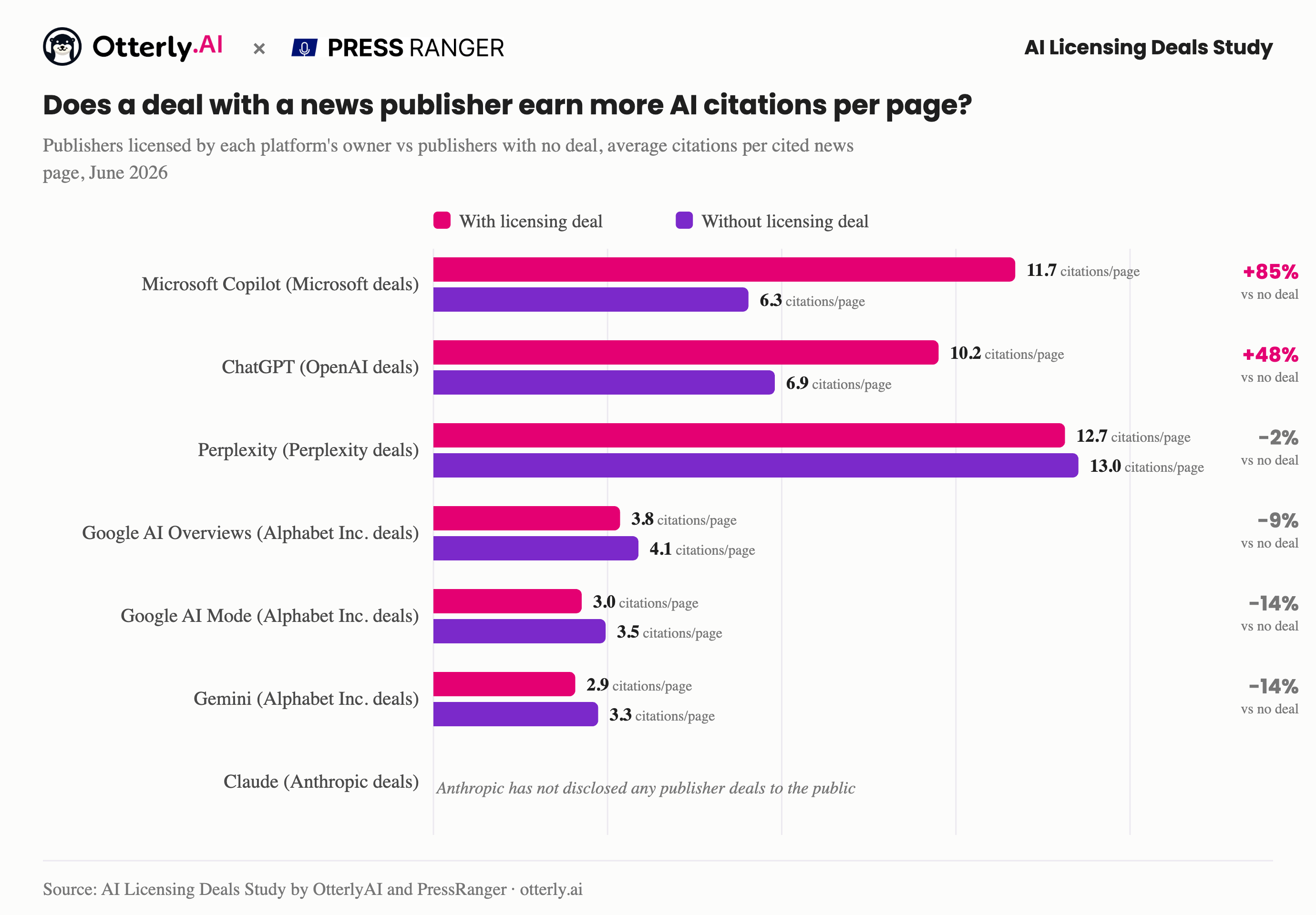
Press Ranger and OtterlyAI released a joint study on Aug. 20 reporting that publishers with OpenAI licensing agreements received 48% more ChatGPT citations per cited page than publishers without such deals. The reported gap, 10.2 citations per page versus 6.9, gives media companies and AI-search vendors a new data point for judging whether licensing may be associated with distribution inside AI answers.
The analysis matched 129.3 million citations from more than 20 million URLs against 91 confirmed AI-publisher agreements covering 314 publisher domains. OtterlyAI collected citation activity across ChatGPT, Google AI Overviews, Google AI Mode, Perplexity, Microsoft Copilot, Gemini and Claude during June 2026; Press Ranger supplied the deal database, which it says was supported by public records through July 28.
The result is an observational comparison, not evidence that an OpenAI agreement itself raises a publisher's citation rate. The announcement does not provide a full methodology or disclose controls for variables including publisher scale, content mix or other factors that could affect how often a site is cited.
Do OpenAI publisher deals increase ChatGPT citations?
The study identifies an association, rather than demonstrating causation. Its narrower comparison found that publishers licensed only by OpenAI received 112% more ChatGPT citations per page than unlicensed publishers, according to the companies.
Across all seven platforms, the OpenAI-licensed group averaged 10.7 citations per cited page, compared with 7.3 for unlicensed publishers, a reported 46% difference. ChatGPT accounted for 57.9% of the OpenAI cohort's AI citation volume, the study found.
In the study's reported comparisons for two other platforms, Google-licensed publishers were cited slightly less often than comparable unlicensed publishers in Google AI Overviews, while Perplexity-licensed publishers were at parity on Perplexity. Those findings are limited to the comparisons reported by the study.
Licensing terms are not uniform
Publisher agreements with AI companies can cover different rights, including AI training data, attributed summaries and links in answers, or product collaboration. Digiday has reported that the details vary: The Washington Post's OpenAI agreement covered ChatGPT summaries, quotations and links without mentioning model training, while other agreements have included content use and product access.
That makes “licensed” a broad category. The study does not separate the reported citation gap by contract scope, financial terms, publisher audience or whether content was delivered through a live feed.
The announcement also pointed to a less concentrated route to AI visibility. News represented 7.2% of all citations in the dataset, while five media groups, Future plc, Forbes, People Inc., Condé Nast and Hearst, accounted for 69% of citations to licensed publishers. Across 16 U.S. industries, the companies reported that niche and trade outlets held the majority of news citations in 15 sectors and attracted 213% more citations than mainstream media.
For operators buying media or measuring answer-engine visibility, the AI publisher licensing citation study offers a benchmark, not a pricing formula. It suggests that deal status is worth tracking alongside citation performance, while leaving open whether licensing, publisher characteristics or both explain the difference.