Nvidia open weights models push pressures US AI labs on model access
Jensen Huang backed an open letter supporting open-weight AI as OpenAI, Meta and Anthropic split over Chinese model risk.
By Dominic Okoye · Staff Writer
· 3 min read
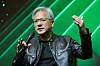
Nvidia CEO Jensen Huang put Nvidia open weights models politics on the industry agenda by endorsing an open letter backing downloadable AI models, with Meta, Microsoft, IBM, Dell and Nvidia among the initial signatories. The letter did not announce funding, but it lands as Nvidia’s AI business is tied to large infrastructure commitments with OpenAI and Anthropic, and as US companies argue over whether Chinese open-weight models should face tighter limits.
Open-weight models are AI models whose weights can be downloaded, modified and run on a customer’s own infrastructure. That matters to enterprises that want more control over data, cost and deployment than a hosted proprietary model can offer.
Huang used his first post on X, formerly Twitter, to promote the letter’s argument that open models can “strengthen safety and cybersecurity, accelerate innovation and diffusion, and enable sovereignty.” He added that “the world needs both frontier closed models and frontier open models.”
The signer list has since expanded. OpenAI and SpaceX were added after the letter’s release, according to the announcement. OpenAI CEO Sam Altman quoted Huang’s post and wrote that he wanted the US to win in both open source and proprietary AI. Elon Musk also backed Huang’s position, writing that it had his full support.
Why is Nvidia backing open weights models?
Nvidia sells the compute behind both closed and open AI systems, so a broader model market supports a broader accelerator market. A move that limits enterprise access to Chinese open-weight models would leave US customers with fewer credible self-hosted options, particularly if American labs do not release competitive open models.
The financial context is hard to ignore. Nvidia has announced billions of dollars of investments in AI startups including OpenAI and Anthropic, often linked to infrastructure buildouts. OpenAI and Anthropic have $30 billion and $10 billion, respectively, in capital tied to Nvidia that may or may not be fully realized, according to the reported terms cited in the debate.
The Wall Street Journal reported Sunday that Nvidia could go much further with OpenAI through a possible $250 billion backstop to help the company lease capacity from a planned $10 billion SoftBank data center in Ohio. Nvidia has not announced such a deal.
OpenAI has released open-weight systems before. GPT-2 qualified in 2020, and last year the company released GPT-OSS models at 20 billion and 120 billion parameters. Those models were behind OpenAI’s own proprietary systems, and the open-weight field has since become more competitive, with Chinese developers including DeepSeek, MiniMax, Z.AI and Moonshot drawing attention.
Meta also appears to be returning to the category. Chief AI Officer Alexandr Wang said last week that Meta would get back into the open model race. Meta had used Llama as a major open-weight differentiator, then shifted toward proprietary models after Llama 4 drew a weak reception. Its proprietary Spark Muse model debuted earlier this year.
Anthropic remains the major holdout. In a Monday blog post, CEO Dario Amodei wrote that “Anthropic has never advocated for a ban on open-weights models,” but said his concern is models from authoritarian governments, especially China. He argued open-weight models can carry higher risk because guardrails are harder to enforce and released weights cannot be withdrawn.
Amodei called for three measures: blocking exports of high-end accelerators to China, cracking down on large-scale model distillation operations, and requiring safety testing for powerful models. Anthropic has not said it plans to release open-weight models.
Nvidia also announced the Open Secure AI Alliance on Monday, a cybersecurity effort meant to give defenders access to open frontier models and related tools. The announcement follows a recent incident in which OpenAI said its models powered an agentic cyberattack on Hugging Face infrastructure, while Hugging Face’s response reportedly turned to uncensored Chinese models after safeguards interfered with analysis.
This story draws on original reporting from The Register.