Astronomers report a Jupiter-mass exomoon candidate 73 light-years away
A Nature paper describes a large object orbiting a brown dwarf, offering a possible route to clearer exomoon detections.
By Renata Fuchs · Policy Reporter
· 3 min read
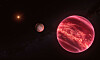
Astronomers have reported evidence for a possible moon outside the Solar System: a Jupiter-mass object orbiting a brown dwarf about 73 light-years from the Sun. The result, published this week in Nature, is not a clean confirmation of an exomoon, but it points to a detection method that could matter as instruments improve.
Kevin Hoy, a PhD student affiliated with Universidad Diego Portales and the European Southern Observatory in Chile, led the work on a system in the southern sky. The object his team found appears to orbit a brown dwarf, which itself orbits a star. That hierarchy is what makes the terminology difficult.
Brown dwarfs sit between gas giants and the smallest stars. They lack enough mass to maintain the hydrogen fusion that powers main-sequence stars, though they can fuse deuterium. The companion in this case is about 30 times the mass of Jupiter, according to the research. The newly identified object orbiting it has a minimum mass of roughly nine-tenths that of Jupiter and completes an orbit every 170 days.
Hoy said in a statement that Solar System labels do not map neatly onto this system. He said the candidate is massive enough to be considered a planet, but because it does not orbit a star directly and instead circles an object that circles a star, the team is inclined to call it a moon. The researchers refer to it more cautiously as an exosatellite.
Why the detection is hard to classify
The ambiguity is not cosmetic. Exoplanets have been confirmed since the early 1990s, including the first planets found around a pulsar in 1992 and the first exoplanet orbiting a Sun-like star, 51 Pegasi b, in 1995. Exomoons, despite the hundreds of moons known in the Solar System, remain unconfirmed territory.
The new candidate is also not moon-like in the familiar sense. It is around the mass of Jupiter, not a small rocky or icy body like many Solar System moons. The Nature paper says it is uncertain whether the object will meet criteria for an exomoon, in part because those criteria are not yet clearly defined for systems unlike our own.
The team used the radial velocity method, the same broad approach Michel Mayor and Didier Queloz used to detect 51 Pegasi b. The method looks for the gravitational wobble caused in a host object by an orbiting companion. Astronomers typically apply it to stars. In this case, the host object being tugged is a brown dwarf.
According to the paper, the data support at least one satellite-like companion around the brown dwarf. Models that include two satellites can be made to fit, but the researchers found those configurations to be highly unstable.
A step toward smaller targets
The practical significance is methodological. The paper says this is the first time, to the authors’ knowledge, that this technique has produced evidence for satellites around a companion brown dwarf. That does not settle the exomoon question, but it gives astronomers a target class where the signal may be easier to detect than around smaller bodies.
The researchers argue that, as technology improves, the same approach could be applied to less massive targets. For now, the candidate is closer in scale to a planet than to the moons around Earth, Jupiter or Saturn. Detecting something more like the Solar System’s familiar moons will require sharper instruments and less ambiguous systems.
This story draws on original reporting from The Register.