Allen Control Systems to add autonomous gun turret to Marine anti-drone platform
The Marine Corps will integrate ACS’s Bullfrog weapon station with L-MADIS, extending a gun-based counter-drone system already used by the Army and Navy.
By Dominic Okoye · Staff Writer
· 3 min read
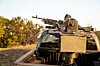
Allen Control Systems said Monday it has a deal with the U.S. Marine Corps to attach its Bullfrog autonomous weapon station to the service’s Light Marine Air Defense Integrated System, known as L-MADIS. Financial terms were not disclosed, but the contract matters because the military is looking for cheaper ways to shoot down drones without spending interceptor missiles on low-cost targets.
Bullfrog is a robotic aiming and targeting system built to work with existing firearms rather than a proprietary launcher. ACS says the system uses AI, computer vision and precision robotics to detect, track and defeat incoming threats at a lower cost than even the cheapest kinetic interceptors. The company’s pitch is straightforward: let the military plug weapons it already owns into an autonomous counter-drone mount.
The Marine Corps deployment will pair Bullfrog with L-MADIS, an expeditionary counter-drone system made up of two off-road vehicles. One vehicle carries the sensing equipment, while the other is expected to carry the Bullfrog weapon station, according to ACS.
ACS offers Bullfrog variants for several weapons, including the M240 machine gun and M2 .50-caliber machine gun. The company is also working on versions for the M230 chain gun and M134 minigun. For the Marine Corps deal, ACS’s announcement links to the Bullfrog page for the M240 variant, indicating that the service is taking at least that configuration.
The M240 version is the smallest Bullfrog configuration described by ACS. It fires 7.62×51 mm NATO ammunition at up to 850 rounds per minute, and ACS lists its effective range in Bullfrog as up to 800 meters. The company says the Bullfrog M240 can defeat drones through Department of Defense Group 3, a category that includes unmanned aircraft under 1,320 pounds, operating below 18,000 feet above sea level and at airspeeds under 250 knots.
That does not cover the largest U.S. military drone classes. The Pentagon’s drone categories extend to Group 5, which includes systems such as the RQ-4 Global Hawk.
Videos posted by ACS show Bullfrog systems shooting down small drones during demonstrations. Another short video on the company’s YouTube channel appears to show a Bullfrog unit shifting from aerial targets to ground targets. ACS did not disclose in the announcement what software or operating limits, if any, prevent the system from being used autonomously against people or manned vehicles.
The Marine Corps is not the first U.S. service to take the system. ACS said the Army and Navy are already fielding Bullfrog units, making the Marines the third branch to adopt it.
ACS framed the demand around the spread of inexpensive drones in the war in Ukraine and conflicts in the Middle East. That framing tracks with a broader procurement shift: militaries are under pressure to match cheap, plentiful aerial threats with defenses that do not require firing costly missiles at every quadcopter or small fixed-wing drone.
This story draws on original reporting from The Register.