WekaIO ships NeuralMesh 6 and its first AI storage appliances
The storage software company is adding purpose-built hardware as inference workloads put pressure on GPU memory, data movement and data center power.
By Dominic Okoye · Staff Writer
· 3 min read
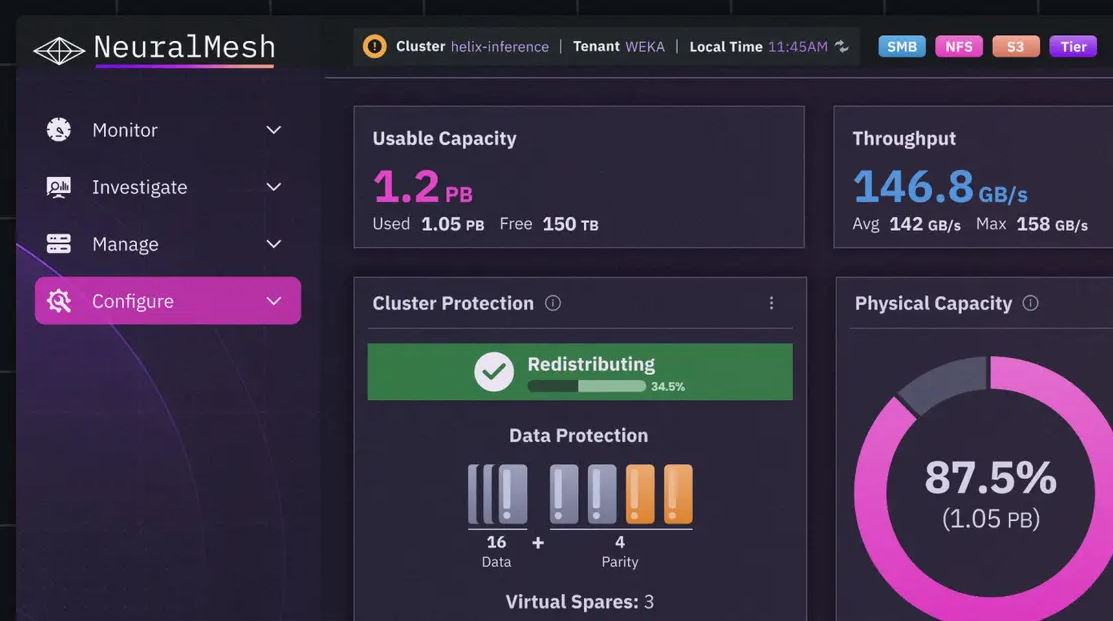
WekaIO announced NeuralMesh 6, a major update to its AI data platform, and introduced its first custom storage appliances for production inference workloads. The company is moving beyond software-only positioning with WEKApod Nitro, WEKApod Prime and WEKApod Prime Max, a notable shift for a vendor that has built its pitch around distributed data management rather than owning the box.
The company did not disclose pricing, availability dates, customer names or revenue impact for the new systems. WekaIO framed the release around a shift in enterprise AI spending from model training toward inference, including long-context reasoning, retrieval-augmented generation and so-called agentic workflows.
WekaIO says NeuralMesh 6 is designed to reduce storage and memory bottlenecks that show up when companies run AI models in production. The central technical claim is an “augmented memory grid” that places the key-value cache on NVMe storage, with the goal of reducing repeated computation by GPUs during inference. According to WekaIO, NeuralMesh 6 using NVMe produced 10 times higher token throughput and supported 10 times more concurrent users on Oracle Cloud Infrastructure than standard DRAM in its benchmark.
That benchmark is the main performance number WekaIO disclosed. The company did not provide broader third-party validation in the announcement, nor did it specify the full test configuration, model, workload mix or cost assumptions behind the comparison.
Software stack adds multitenancy and file-object convergence
Beyond the GPU memory claim, NeuralMesh 6 adds native hyperscale multitenancy, a unified file and S3 object protocol stack running directly on NVMe, and always-on data reduction with performance guarantees, according to WekaIO. Those features target a common production AI problem: teams often keep separate storage systems for file-heavy model pipelines and object-heavy data repositories, then rely on manual movement between them.
Ajay Singh, WekaIO’s chief product officer, said many production AI environments were assembled from available platforms, processors and networking gear rather than designed as a single system. He argued that NeuralMesh 6 gives customers one platform for high-performance file access and high-capacity object storage on the same underlying blocks, with multitenancy, data mobility and efficiency features included.
WEKApod marks a hardware turn
The hardware release is the bigger strategic signal. WekaIO says the WEKApod line is built on a PCIe Gen 6 internal fabric and uses a software-managed thermal design intended to improve density and performance. The company said the systems were built for AI inference environments where data center space, power supply and GPU utilization are constraints.
WEKApod Prime and WEKApod Prime Max support up to 245 terabytes of ultra-dense solid-state drives. WekaIO says NeuralMesh data reduction can raise that to as much as 1.1 exabytes of effective capacity in a single 56-unit rack. WEKApod Nitro is positioned as a lower-cost option for high-concurrency deployments where storage bandwidth affects GPU utilization.
Liran Zvibel, WekaIO’s co-founder and chief executive, said the company still considers NeuralMesh its core product and remains software-first. His explanation for the hardware move was that customers’ inference economics required tighter control over the underlying platform, rather than leaving performance limits to general-purpose server designs.
For buyers, the question is whether WekaIO’s vertically integrated appliance approach can reduce the operational drag of AI inference enough to justify another specialized infrastructure layer. For WekaIO, the move puts more of the stack under its control, but it also makes hardware execution, supply, support and margins part of the story.
This story draws on original reporting from SiliconANGLE.