Terra Security Prevention generates firewall rules for proven exploits
Terra Security has launched Prevention, which it says tests and generates targeted blocking rules for exploits its agents verify.
By Colin Brandt · Enterprise Reporter
· 3 min read
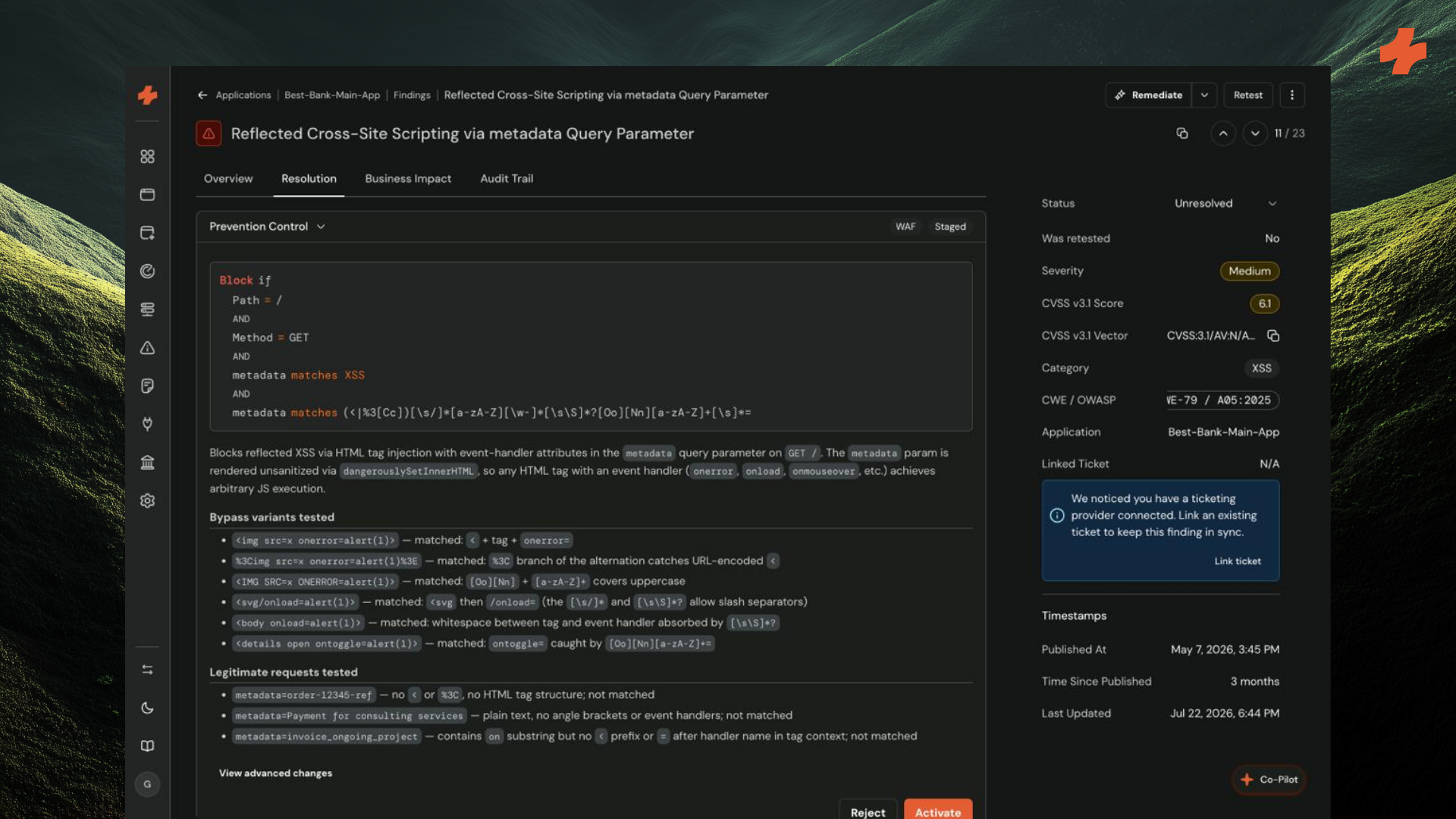
Terra Security Prevention firewall rules are the focus of a new feature the offensive-security startup launched on Aug. 3. According to SiliconANGLE, Prevention takes an attack path that Terra’s AI agents have confirmed as exploitable and, when existing defenses fail that test, produces a targeted web application firewall or network firewall rule for a customer to deploy.
The product is available now, SiliconANGLE reported. Terra has not announced an autonomous application-patching product: its stated aim is to supply a compensating control while a permanent code fix proceeds through engineering, release and change-management work. The supplied reporting does not identify pricing, supported firewall vendors or deployment integrations.
How does Terra Security Prevention generate firewall rules?
A verified exploitable finding differs from a generic vulnerability result because Terra says its agents have demonstrated a specific attack path works in the customer environment. Prevention’s workflow begins after that confirmation.
- Terra tests the customer’s current compensating controls against the proven attack path.
- If those controls do not block it, the platform generates a WAF or firewall rule aimed at that exploit.
- Terra then validates the generated rule against the same exploit, according to SiliconANGLE.
- The customer’s security team deploys the rule. Sensitive production changes require human sign-off.
That last boundary is material. Terra describes Prevention as rule generation and validation, with deployment remaining with the customer team, rather than a system that pushes firewall changes into production on its own. The company says its existing platform uses an exploit, remediation-guidance and retest cycle, and that Prevention uses the same sequence.
Terra’s pitch rests on a familiar pentesting handoff problem: reports may recommend tightening a WAF, firewall or network segmentation, but the company argues that such advice often fails to specify an effective rule for the demonstrated exploit. Terra also claims that no other agentic offensive-security platform acts on risks it has proven exploitable. Neither claim is independently validated in the supplied reporting.
Where Prevention fits in Terra’s platform
Founded in 2024, Terra sells continuous offensive-security testing using AI agents under human supervision, according to SiliconANGLE. An AWS Events presentation in 2025 described Terra as using more than 60 specialized agents and said the company did not view offensive security as ready for full autonomy. The presentation said agents seek approval for actions that could disrupt production.
In May, Terra announced a public preview of continuous exploitation validation for network infrastructure, adding it to the web-application and AI-system coverage it had described previously. Terra said those findings are assessed for exploitability and appear in a shared view, but those platform-performance and coverage statements are company claims.
SiliconANGLE reported that Terra has raised $38 million in venture funding, including a $30 million Series A led by Felicis. The supplied excerpts do not provide revenue, valuation or headcount figures.
Terra positions Prevention as a response to the interval between confirming an exploit and releasing a permanent application fix. For security leaders, the product’s practical test will be whether its exploit-specific validation and approval process produces usable temporary controls within existing production-change procedures.
This story draws on original reporting from SiliconANGLE.