Gemini Robotics 2 gives Google DeepMind a fuller robot control stack
Google DeepMind introduced Gemini Robotics 2, a model series for humanoid robots that plans tasks, controls whole bodies and adds safety tests.
By Colin Brandt · Enterprise Reporter
· 3 min read
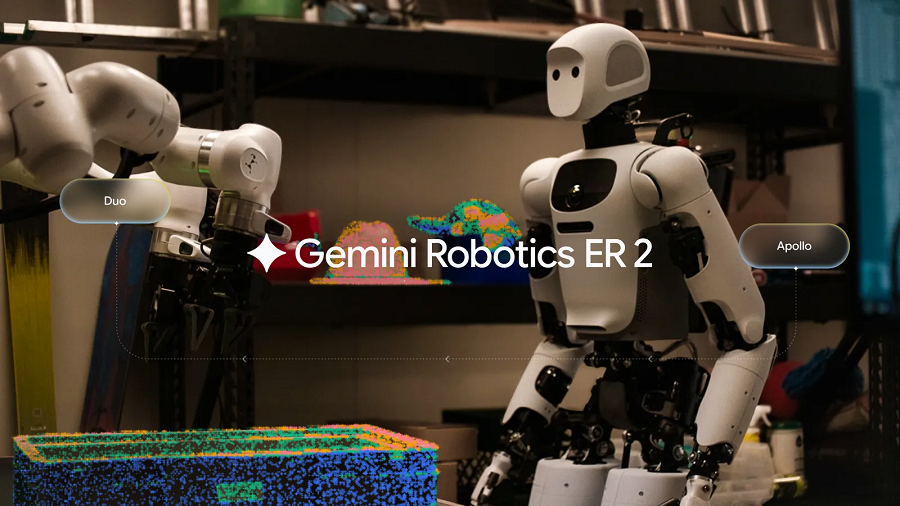
Google DeepMind introduced Gemini Robotics 2, a family of AI models built for humanoid robots, with software for planning work, coordinating multiple machines and translating instructions into movement. The Alphabet Inc. lab says the system can handle tasks with hundreds of steps over several minutes, a claim that matters for robotics teams trying to move beyond short demos and scripted manipulation.
The launch covers three models: Gemini Robotics ER 2 for high-level task planning, Gemini Robotics 2 for whole-body robot control and Gemini Robotics On-Device 2 for running control software on a robot’s own computer. Google did not disclose pricing, customer deployments or comparative benchmark results for the new models.
What is Gemini Robotics 2?
Gemini Robotics 2 is Google DeepMind’s new model series for humanoid robots. It combines an embodied reasoning model, which decides what a robot should do, with VLA models that turn those plans into lower-level motor instructions.
Many humanoid systems use that split design. One model produces the task plan, while another model converts the plan into commands the robot can execute through its motors and hands. Google’s release extends that pattern across planning, execution and on-device deployment.
The planning model, Gemini Robotics ER 2, lets a user describe a job in natural language. According to Google DeepMind, ER 2 can break down long tasks, assign parts of the work to different robots and use external cloud services through tool calling. Google gave Search as an example of a service the model could use when it needs more context about a prompt.
DeepMind also says ER 2 can monitor a robot’s progress through continuous camera footage. If a robot fails partway through a task, the model is designed to identify the last completed step and continue from there instead of restarting the full job. Google engineers Steven Hansen and Peng Xu wrote that the model can track progress, adjust after errors and decide when to move to the next step by watching video feeds.
How the models split the work
After ER 2 creates a plan, the instructions can be passed to one of two VLA models in the series. Gemini Robotics 2 is built to control a humanoid robot’s full body, rather than only its hands. Google DeepMind says that lets the model manage the robot’s center of gravity to reduce fall risk, while also supporting a wider range of robotic hands than earlier DeepMind software.
The second execution model, Gemini Robotics On-Device 2, is designed to run locally on a robot’s onboard computer. DeepMind says it can be adapted to a new robot after a few hours of training. That detail is relevant for hardware companies because model portability across robot designs is one of the practical constraints in the category.
For developers, ER 2 is available through Google Cloud, the Gemini API and Google AI Studio. The release also includes a safety evaluation tool called the ASIMOV-Agentic Benchmark, which Google says is intended to measure whether humanoid robots can avoid collisions and other hazards.
The announcement gives Google DeepMind a broader position in humanoid robotics software, spanning reasoning, whole-body control and safety testing. The open question for operators is how well the models perform outside controlled demonstrations, especially on long jobs where physical errors, hardware differences and ambiguous instructions compound quickly.
This story draws on original reporting from SiliconANGLE.