AMD pushes rack-scale AI systems as server share rises
AMD is positioning ROCm, Helios and partner deals as an open alternative to Nvidia’s vertically integrated AI infrastructure stack.
By Colin Brandt · Enterprise Reporter
· 4 min read
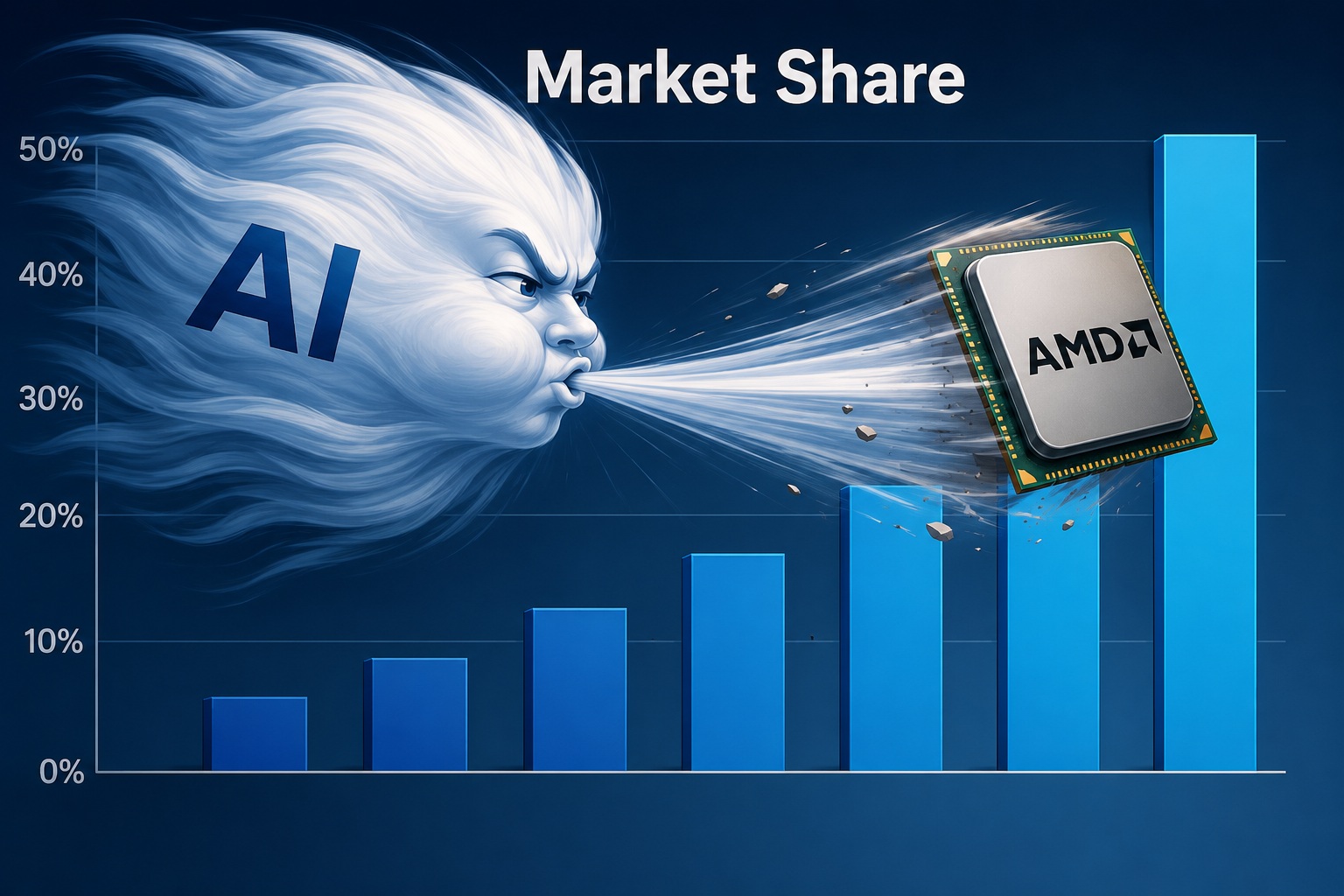
Advanced Micro Devices is using AI demand to expand from server processors into rack-scale systems, open software and hybrid infrastructure, according to company announcements and analysts at theCUBE Research. The company has not disclosed revenue for this systems push, but its x86 server processor revenue share has climbed from 8% five years ago to a claimed 46%, giving AMD more leverage with enterprise infrastructure buyers.
The shift is aimed at a market still shaped by Nvidia’s lead in AI accelerators and software. AMD’s argument is that enterprises want more choice across CPUs, GPUs, networking, storage and orchestration software as they move AI workloads across data centers, cloud and edge environments. That claim depends on AMD proving it can sell a platform, rather than parts.
From CPUs to rack-level infrastructure
AMD’s current position follows a long recovery. Founded in 1969, the company endured years of pressure from Intel and Nvidia, and its valuation was roughly $3 billion in 2014, the year Lisa Su was named president and chief executive. Since then, AMD has rebuilt its server business around EPYC CPUs and, more recently, Instinct GPUs for AI workloads.
Dave Vellante, chief analyst at theCUBE Research, said AMD has moved from a distressed position into a major supplier for high-performance and AI computing under Su’s leadership. His view frames AMD’s recent gains as more than a CPU share story: the company is trying to compete in the full AI infrastructure stack.
That is the point of AMD’s ROCm software effort. ROCm, the company’s open-source software stack for programming AMD GPUs, is AMD’s alternative to Nvidia’s CUDA ecosystem. AMD says ROCm supports AI and high-performance computing across data center and client platforms. The commercial pitch is lower lock-in and more flexibility for enterprises that do not want to rebuild around a single proprietary stack.
Paul Nashawaty, practice lead and principal analyst for application development, modernization and cloud-native at theCUBE Research, said AMD’s AI strategy now combines accelerated compute, open software and ecosystem partnerships. TheCUBE Research has also reported that 92% of organizations are integrating AI into at least one part of the software development lifecycle, while 72% say open and interoperable ecosystems help speed production deployment by reducing integration complexity and dependence on proprietary platforms.
Helios puts AMD against Nvidia systems
AMD’s most concrete systems move is Helios, a rack-scale AI platform introduced at the Open Compute Project Summit in 2025. The system includes 72 MI450 GPUs and is specified to deliver 1.4 exaFLOPs of FP8 performance, with 31 terabytes of HBM4 memory and 1.4 petabytes per second of aggregate memory bandwidth.
Helios is built around AMD Instinct GPUs, EPYC CPUs and Pensando networking. It is positioned against Nvidia’s Grace Blackwell and Vera Rubin systems, according to SiliconANGLE. OpenAI Group PBC and Meta Platforms Inc. have committed to large-scale deployments of MI450-based infrastructure, with initial systems based on Helios, according to the reported announcements.
Suresh Andani, AMD’s corporate vice president for compute and enterprise AI, told theCUBE that agentic AI workloads require both CPUs and GPUs because planning and orchestration include serial tasks that GPUs do not handle efficiently. His argument is practical: idle accelerators are an expensive utilization problem, and AMD wants to sell the CPU-GPU mix as part of the answer.
Partners carry the enterprise route
AMD is also using partnerships to reach enterprise buyers. In February, it announced a multiyear strategic partnership with Nutanix to build a full-stack AI infrastructure platform for agentic AI applications. The deal included a $150 million investment in Nutanix common stock and up to $100 million for joint engineering and go-to-market work, plus optimization of Nutanix Cloud and Nutanix Kubernetes Platforms on AMD CPUs and GPUs.
With Dell Technologies, AMD has extended a 20-year relationship. In May, AMD released the Instinct MI350 PCIe card, pairing it with Dell PowerEdge servers for customers that want AI inference capacity inside existing data center infrastructure. Melissa Crichton, Dell’s vice president of server and AI solutions, told theCUBE that the companies see enterprise demand for PCIe-based GPU workloads.
AMD is also working with Hewlett Packard Enterprise. The companies built a U.S. government supercomputer rated at 16.7 exaflops for AI processing, and they are collaborating on another system intended to deliver three times that performance using circuits based on AMD’s CDNA 4 GPU architecture.
The open question is execution. AMD has the server share, product roadmap and partner list to be taken seriously beyond CPUs. It still has to show that ROCm and Helios can create a durable enterprise platform business in a market where Nvidia’s software advantage remains the benchmark.
This story draws on original reporting from SiliconANGLE.