AMD Instinct MI400 launch targets AI factories and robotics
AMD announced MI400 GPUs, EPYC 9006 CPUs, Helios racks and robotics tools as it tries to give AI buyers a broader Nvidia alternative.
By Wei-Lin Zhao · AI Correspondent
· 3 min read
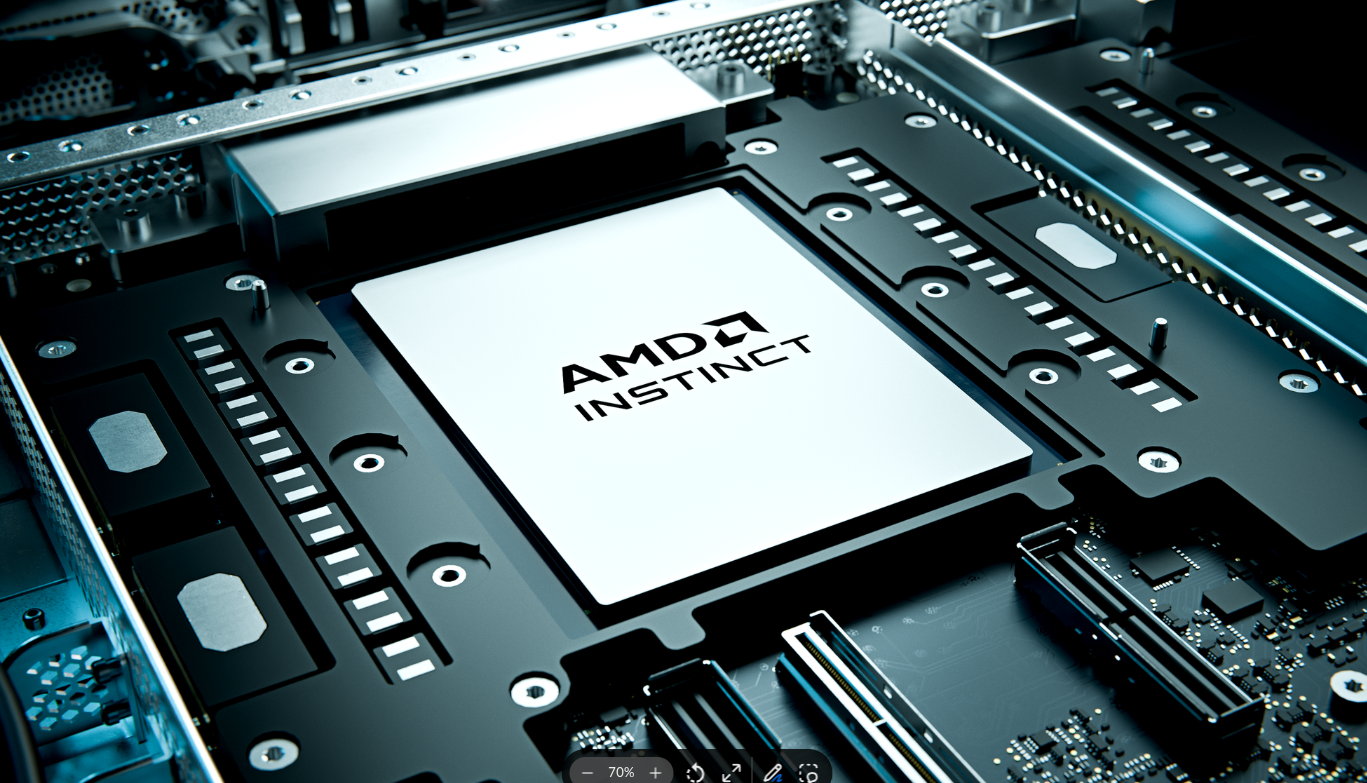
Advanced Micro Devices Inc. used its Advancing AI 2026 event in San Francisco to announce the AMD Instinct MI400 launch, alongside sixth-generation EPYC server CPUs, a Helios rack-scale data center system and new robotics products. The package is aimed at frontier models, agentic AI workloads and autonomous robots, putting AMD more directly against Nvidia Corp. across both cloud AI infrastructure and edge robotics.
AMD Senior Vice President of AI Vamsi Boppana said different categories of advanced AI, including frontier AI, sovereign AI and scientific computing, increasingly require infrastructure tuned to specific workloads. AMD framed the MI400 series as part of an open software approach, rather than a single-purpose accelerator announcement.
What is AMD Instinct MI400?
AMD Instinct MI400 is the company’s next GPU family for AI and high-performance computing systems. The lineup includes the MI455X, which AMD is pitching for large-scale inference, AI training and fine-tuning in AI factory deployments, and the MI430X, which is aimed at sovereign AI and scientific workloads.
AMD said the MI430X delivers 288 teraflops for advanced scientific applications. Both MI400 chips use HBM4 high-bandwidth memory, and AMD said the systems include encrypted GPU-to-GPU network connections for workloads where security is part of the infrastructure requirement.
EPYC CPUs and Helios racks fill out the system pitch
AMD also introduced the EPYC 9006 series server CPUs, positioning them as companion processors for agentic AI systems. Agentic AI workloads use models to reason over data, plan tasks, run code and call external tools, which makes CPU coordination relevant for sandboxing, memory management and feeding data to GPUs.
Dan McNamara, AMD’s senior vice president and general manager of Compute and Enterprise AI, said the company sees agentic workloads as more efficient when CPUs and GPUs are deployed together. The EPYC 9006 SP7 has 256 cores and 512 threads for high-density agent sandbox execution. The EPYC 9006 SP8 ranges from eight to 128 cores for power-constrained systems. The EPYC 9006X SP7 targets data-heavy HPC and modeling, with speeds of up to 5.15 gigahertz and three times the L3 cache per core of the standard SP7. AMD also announced EPYC 9006 LP “Verano,” a low-power CPU intended to serve as an AI host node.
For buyers that want integrated infrastructure rather than separate components, AMD announced Helios, a rack-scale system combining Instinct GPUs, sixth-generation EPYC CPUs, ROCm software and Pensando networking. AMD said one Helios rack has 18 open-rack trays and supports 72 GPUs, with up to 2.9 exaflops of peak FP4 performance, 1.4 exaflops of peak FP8 compute and 31 terabytes of HBM4 memory.
AMD also claimed Helios can deliver 15% higher peak FP4 performance, 50% more HBM capacity and token costs up to 30% lower than Nvidia’s NVL72 rack systems. Those are AMD’s comparisons, and the company did not give a general availability date for the MI400 GPUs or EPYC 9006 CPUs. It said first samples are expected to ship later this year.
AMD pushes into robotics
AMD’s robotics announcements center on Kria AI Solutions and the Kria AI Robotics Developer Platform, which combines CPUs, GPUs, neural processing units and field-programmable gate arrays for autonomous robots. AMD said the platform can support more than 8,000 decisions per second and sub-millisecond vision-language-action reasoning.
The Kria platform uses the new Ryzen AI Embedded X100 Series processors, which combine up to 16 Zen 5 CPU cores, an RDNA 3.5 integrated GPU and an energy-efficient NPU on one system-on-chip. AMD said the processors are designed to operate from 105°C to minus 40°C for up to 10 years.
AMD also launched the AMD Robotics Partner Network for original design manufacturers, sensor suppliers and software vendors. The network is built around AMD’s ROCm software stack, which AMD said preserves about 75% of CUDA code during migrations, a direct appeal to robotics companies already tied to Nvidia software and hardware.
This story draws on original reporting from SiliconANGLE.