AMD Helios benchmark claims put pressure on software execution
AMD says Helios beats Nvidia Vera Rubin on several AI system metrics, but outside analysis says validation capacity may decide the race.
By Dominic Okoye · Staff Writer
· 3 min read
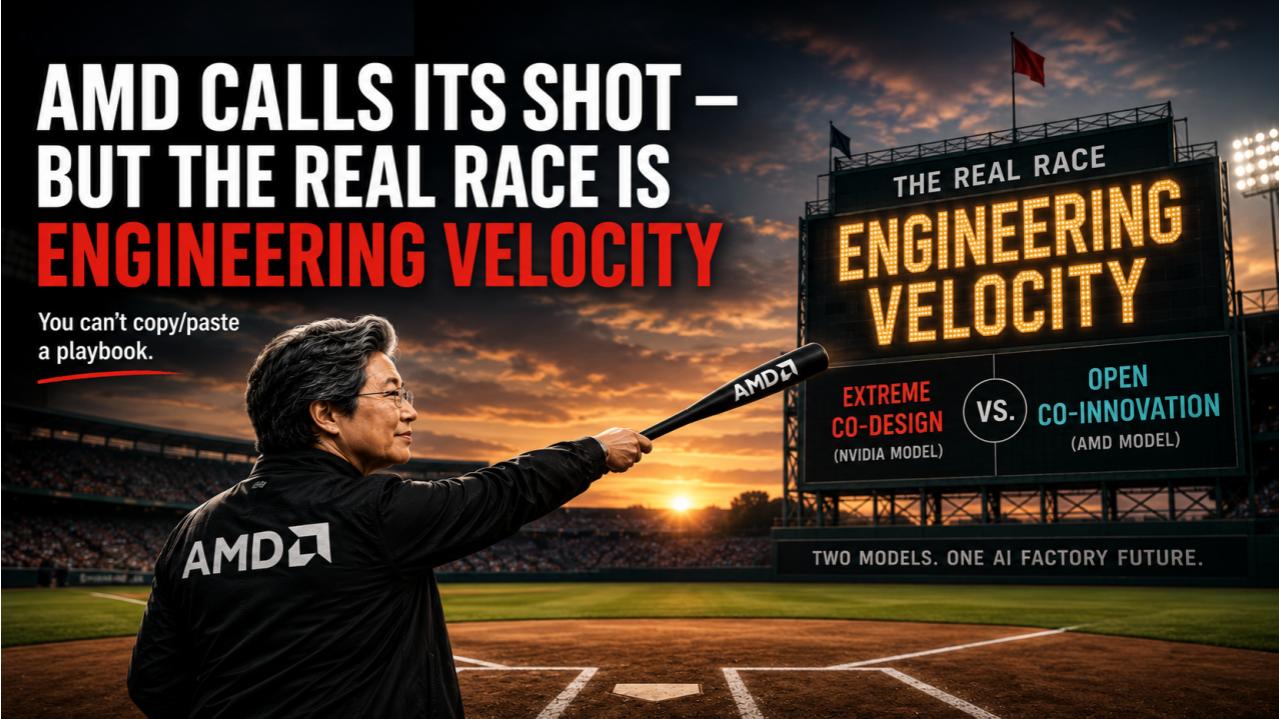
AMD used its Advancing AI event to position Helios, Instinct MI455X, Venice and ROCm as more than alternatives to Nvidia, with Chief Executive Lisa Su asserting leadership across AI infrastructure categories. The AMD Helios benchmark at the center of the pitch claims better rack-scale economics than Nvidia’s forthcoming Vera Rubin system, but the harder test will be whether AMD can turn those claims into production results.
According to SiliconANGLE’s theCUBE Research, AMD said Helios would deliver about 15% more compute, 50% more HBM capacity, 50% more scale-out bandwidth and up to 30% more tokens per dollar than Nvidia Vera Rubin. The analysis said AMD’s comparison used a mix of its own specifications, measurements and modeling, along with public information about Nvidia’s unreleased platform.
That distinction matters for buyers planning AI clusters. The figures are not yet independently reproduced, side-by-side results from commercially deployed systems. No booked revenue, production win rate or customer economics tied to those benchmark claims were disclosed.
What did AMD claim about Helios?
Helios is AMD’s rack-scale AI system architecture, presented as part of a broader stack that includes EPYC CPUs, Instinct accelerators, ROCm software and Pensando networking assets. AMD’s event pitch was that Helios can compete with Nvidia not only at the chip level, but across memory, networking, system throughput and cost per generated token.
TheCUBE Research framed the competitive issue as “engineering velocity”: how quickly a vendor can improve silicon, software, testing, validation and customer feedback across the full AI platform. In that framing, Nvidia’s advantage comes from what the analysis calls an integrated “Extreme Co-Design” model across silicon, software, networking and systems. AMD is pursuing a more distributed “Open Co-Innovation” model involving customers, partners and open-source communities.
SemiAnalysis added a more technical constraint to that debate. It reported that AMD’s software progress is real, including as much as an 18-times improvement in Kimi K2.5 interactivity in less than 30 days through changes around AITER and vLLM. SemiAnalysis also said AMD was working toward at least 90% parity with CUDA on vLLM merge-gating tests by the Advancing AI conference, but that instability and reassignment of internal development clusters disrupted the effort.
The same SemiAnalysis report estimated that even after AMD adds thousands of accelerators to its development environment, its stable internal GPU capacity remains more than an order of magnitude below Nvidia’s. TheCUBE Research said it had not independently verified that comparison. The operational point is still material: AI coding agents can generate more code paths, kernels and optimizations, but each change still needs hardware-backed regression testing, performance validation and accuracy checks.
Who is AMD bringing into the AI platform work?
AMD’s partner strategy is central to its case. TheCUBE Research said Meta is working with AMD on networking, scale-up, scale-out and system co-design under a framework targeting up to six gigawatts. OpenAI is tied to frontier-workload requirements and future-system co-design under a deployment framework of up to six gigawatts. Anthropic has plans for up to two gigawatts of Helios, along with ROCm feedback and deployment collaboration.
TensorWave, described as an AMD-native neocloud, is contributing operational feedback. Its CEO Darrick Horton said on theCUBE that the company could target one to two gigawatts of Helios capacity in 2027. Cerebras is a different kind of partner, with AMD using that relationship for disaggregated, ultra-low-latency inference and a joint service expected later this year.
Those are large targets, but they are “up to” commitments and partnership frameworks, not proof of deployed capacity or sustained economics. Some arrangements also include substantial financial incentives, according to theCUBE Research. AMD has made a broader claim than being a second-source GPU supplier. The evidence investors and operators should watch next is independent workload validation, software stability and whether partner feedback reaches production releases fast enough to narrow Nvidia’s platform lead.
This story draws on original reporting from SiliconANGLE.