AMD Advancing AI 2026 puts Helios and Venice against Nvidia
AMD pitched Helios, MI450 and Venice Epyc as a broader AI infrastructure stack, but its strongest performance claims remain company-run.
By Colin Brandt · Enterprise Reporter
· 4 min read
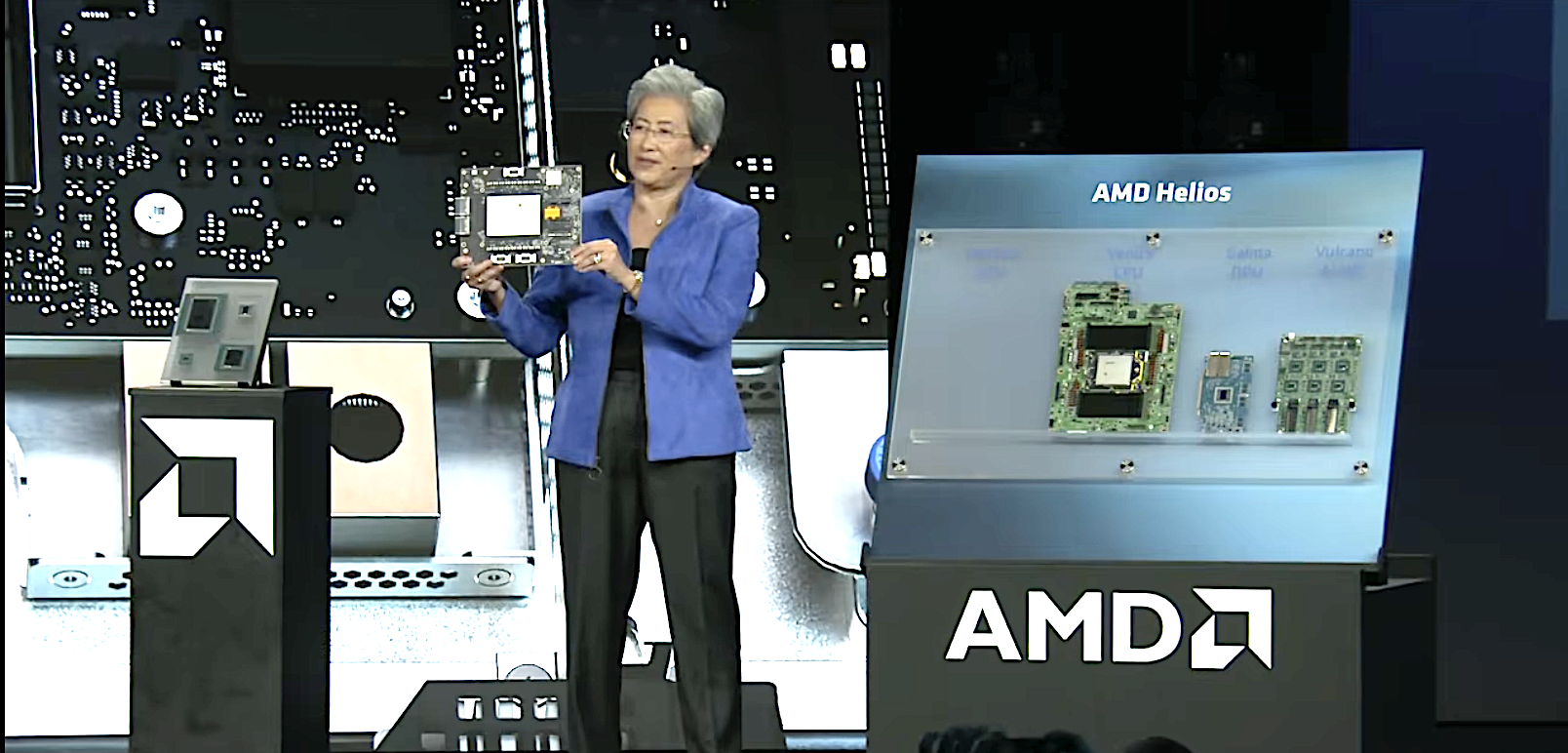
AMD used AMD Advancing AI 2026 to reposition itself as more than a second-source GPU supplier, with Chief Executive Lisa Su presenting Helios racks, Instinct MI450 accelerators, Venice Epyc CPUs and new software tooling as pieces of a full AI infrastructure platform. The company did not disclose pricing, but it claimed performance-per-dollar and power-efficiency gains meant to challenge Nvidia’s system-level lead.
Su framed Helios and MI450 as AMD’s rack-scale answer for AI labs and hyperscalers. According to AMD’s own benchmarks, Helios delivers an average 10% to 15% more performance than unnamed competitors at fixed rack power on high-throughput workloads and leading inference modes. Su also said the system can provide up to 30% more tokens per dollar than the competition.
Those claims are directionally useful for buyers modeling total cost of ownership, but they are still AMD-run numbers. AMD did not identify the comparison systems, model mix or public cloud configurations behind the figures. Until customers publish workload results or cloud providers expose comparable instances, the Helios pitch remains a product claim rather than proof of share shift from Nvidia.
What did AMD announce at Advancing AI 2026?
AMD’s event centered on three infrastructure bets: Helios racks with MI450 accelerators for large-scale AI inference and training, Venice Epyc CPUs for AI servers and agent workloads, and ROCm.AI software with Hyperloom for AI-assisted GPU optimization. The company’s broader argument is that AI systems are becoming data-center-scale designs, where CPUs, GPUs, memory, networking, cooling and power are planned together.
Su cited OpenAI as an early Helios partner. OpenAI’s infrastructure team, according to the presentation, has been working with AMD engineers on GPT-class workloads and expects Helios deployment to begin toward the end of the year, then increase in 2027. OpenAI infrastructure chief Sachin Katti also described AI infrastructure as a data-center-scale problem that requires co-design across compute, storage, networking, power distribution and cooling.
AMD also used the keynote to push CPUs back into the AI buying conversation. Su described three roles for CPUs in AI infrastructure: hosting GPUs, running dense agent servers or sandboxes, and serving general enterprise workloads such as databases and data services. Venice, AMD’s next Epyc family based on Zen 6 and TSMC’s two-nanometer process, is the company’s answer across those tiers.
AMD said Venice can deliver up to 1.8 times the performance of Turin and support up to 512 threads per socket. The lineup includes a Venice HF part for GPU host nodes at up to 5 GHz, a 256-core version aimed at agent sandboxes, and a 128-core version tuned for enterprise performance per dollar. Su also claimed Venice can deliver more than twice the agents per watt for agent sandboxes compared with x86 alternatives and up to 3.3 times more rack-level performance per watt than unnamed Arm competitors in a 100-kilowatt rack.
Cisco’s Jeetu Patel and Meta’s Santosh Janardhan backed the view that AI infrastructure planning is shifting beyond single-chip performance. Patel argued that CPUs and GPUs need to be treated as linked resources across workflows, while Janardhan said data centers and silicon take years to build and should be co-designed for deployments in 2027 and 2028.
On software, AMD introduced ROCm.AI and Hyperloom. Vamsi Boppana, AMD’s senior vice president, described ROCm.AI as an agentic AI platform for AI-assisted GPU programming. Hyperloom, its optimization layer, is designed to analyze workloads, tune configurations, select and tune kernels, adjust parallelism and iterate toward performance targets.
AMD said it has run 14,000 models through Hyperloom internally. In one demo using MiniMax M3 on MI355 systems with VLLM, AMD said an AI agent found a more efficient Mixture-of-Experts GEMM kernel and improved tokens per second by 38%. As with the Helios numbers, buyers will need production evidence before treating staged optimization results as a broader software ecosystem answer to CUDA.
The strategic message was clear enough: AMD wants to compete as an open, co-designed CPU-and-GPU platform rather than as a discount accelerator vendor. The execution burden is also clear. Nvidia still has the dominant AI software base and deployed accelerator footprint, while Intel and Arm vendors are contesting the CPU side. AMD has credible parts of the stack, but the market will judge Helios, Venice and ROCm.AI by delivery, benchmarks and customer adoption rather than keynote positioning.
This story draws on original reporting from SiliconANGLE.