Supreme Court hears Exxon and Suncor bid to halt Boulder climate lawsuit
The justices heard ExxonMobil and Suncor’s preemption challenge to Boulder’s damages case, a ruling that could shape dozens of related suits.
By Dominic Okoye · Staff Writer
· 3 min read
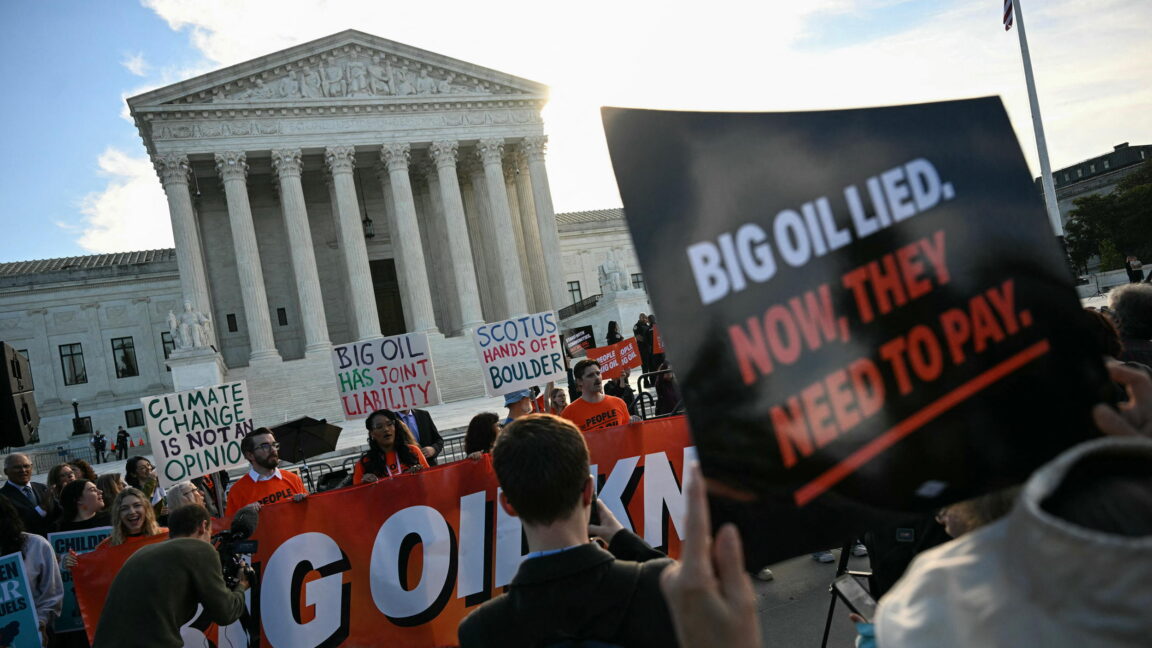
The Supreme Court heard ExxonMobil and Suncor Energy’s effort to stop a Colorado climate damages case before trial on Oct. 5, putting the future of Supreme Court climate lawsuits brought by state and local governments in focus. The companies are appealing a Colorado ruling that let claims by Boulder County and the city of Boulder move toward trial; the plaintiffs seek unspecified monetary damages, not an injunction on oil production.
The case, Suncor Energy Inc. v. County Commissioners of Boulder County, stems from a 2018 state-court lawsuit. Boulder alleges that Exxon and Suncor violated state law by misleading the public about fossil-fuel risks and seeks recovery for climate-related costs, including infrastructure repairs, emergency management and public-health harms. The Supreme Court is not deciding whether those allegations are true, whether the companies caused the claimed harms, or the amount of any damages.
Instead, the immediate dispute is whether federal law blocks Boulder’s state-law claims and whether the justices can intervene before the underlying case reaches a final judgment. Exxon and Suncor argue that federal authority over air pollution, including the Clean Air Act and constitutional principles governing interstate and international pollution, preempts the case.
Boulder’s lawyer, Kevin Russell, told the court the suit concerns alleged deception and local damage costs, rather than an attempt to regulate emissions or set national energy policy. Counsel for the companies argued that allowing the case would let municipalities use damages litigation to influence national and international energy policy.
What could the Supreme Court decide in the Boulder climate lawsuit?
A broad ruling for Exxon and Suncor could end Boulder’s remaining claims and put related state and local cases at risk of dismissal. Exxon and Suncor have said nearly 60 state and local governments have brought dozens of similar suits seeking billions of dollars. The actual scope would depend on how the court frames any preemption ruling.
The court could also take a narrower route, such as rejecting a particular claim or legal theory, without foreclosing every state-law climate case. Or it could conclude that the appeal arrived too early because the Colorado litigation has not produced a final ruling. Either a jurisdictional dismissal or a decision for Boulder would leave the state case on track to continue.
The Colorado proceedings already have been narrowed. According to State Court Report, a Boulder County judge dismissed the consumer-protection claims as inadequately pleaded and time-barred, while tort claims including public nuisance, trespass, unjust enrichment and civil conspiracy proceeded. The Colorado Supreme Court declined the companies’ objections to that result.
Questions at oral argument reflected concerns on both sides. Chief Justice John Roberts asked why state suits should be barred when state litigation has been allowed in comparable situations, while also pressing Boulder on the practical consequences if municipalities across the country brought similar actions, Reuters reported.
Justice Samuel Alito is recused, leaving eight participating justices. A 4-4 split would leave the Colorado court’s judgment intact. Reuters reported that such a split appeared possible following the argument, but the questioning did not establish an outcome. A decision is expected by the end of the term in June.
This story draws on original reporting from Ars Technica.