Nvidia frames Spectrum-X as open Ethernet while defending AI network edge
Nvidia’s networking chief said agentic inference makes networking part of AI compute, while theCUBE Research flagged unresolved lock-in questions.
By Dominic Okoye · Staff Writer
· 3 min read
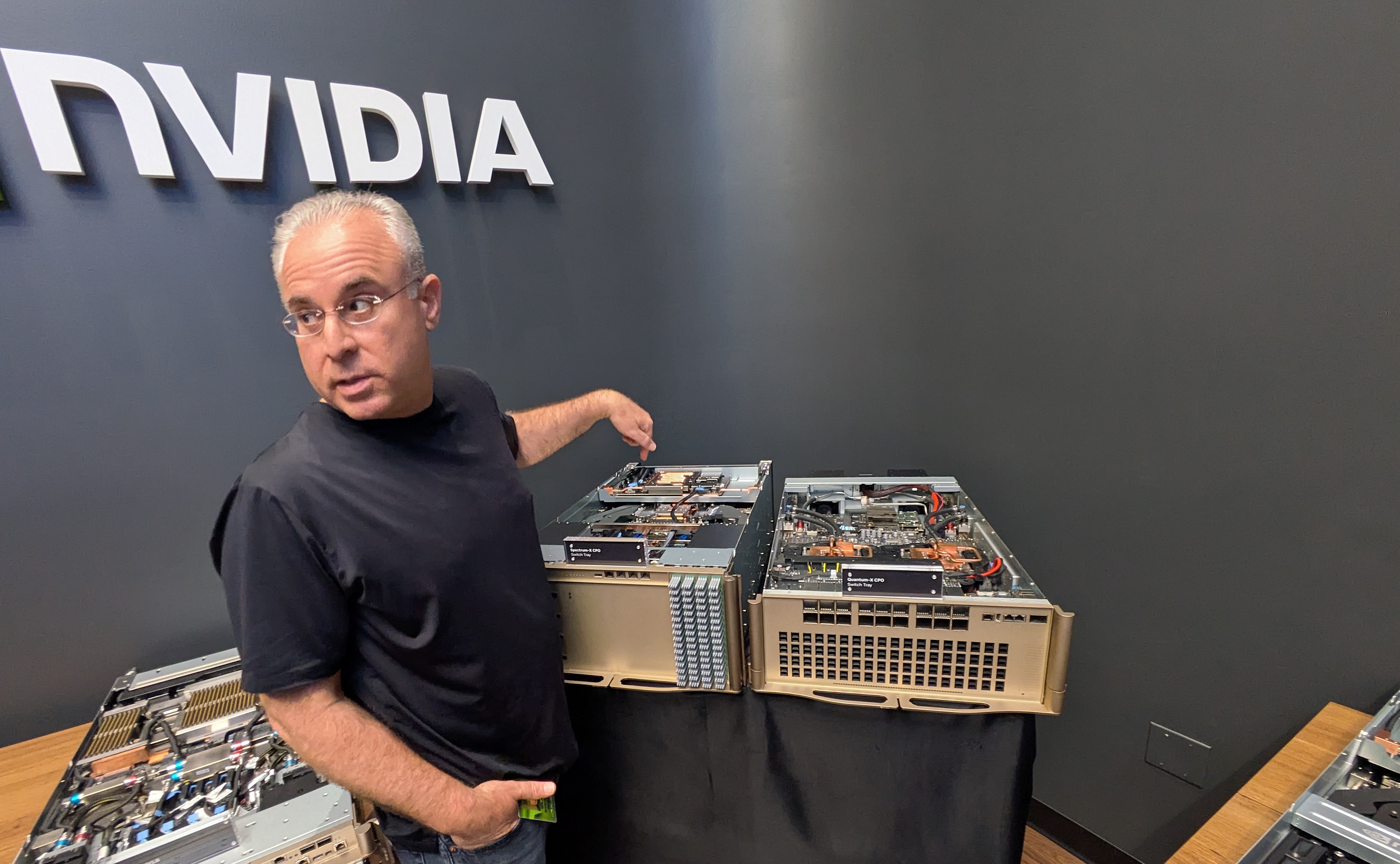
Nvidia is arguing that AI networking has become part of the compute system itself, not a supporting layer, as agentic inference pushes more coordination across GPUs, CPUs, DPUs, storage and memory. In a discussion hosted by Dave Vellante and Bob Laliberte, Nvidia networking chief Gilad Shainer said organizations that do not engineer the network as part of the system have built a server farm rather than an AI factory.
The claim matters because Nvidia’s advantage in AI infrastructure is increasingly tied to system design beyond GPUs. Vellante and Laliberte, writing for theCUBE Research, assessed Nvidia as materially ahead at the full-system level, while also saying its integrated approach leaves buyers with real switching-cost questions.
Inference changes the networking requirement
Shainer said training was complicated, but inference is harder. The analysis qualified that point: frontier training remains computationally demanding, but production inference can be more varied and less predictable, especially with long-context and agentic workloads.
The discussion described inference pipelines that include prompt processing, sequential token decoding, mixture-of-experts traffic, key-value cache movement, scheduling by CPUs, isolation and storage services from DPUs, and service-level management across many users and applications. In that model, the network is expected to handle synchronization, congestion, failure isolation and movement of context across memory tiers.
theCUBE Research cited survey data from 330 respondents showing that 94.6% said networking had become more important or much more important to business goals than two years earlier. The same survey found 65.2% selected “much more important,” 29.4% selected “more important,” 4.8% reported no change and 0.6% said networking had become less important.
The same survey also points to the operational drag. Respondents cited integration between traditional and AI networks at 56.4%, skills at 52.7%, network architecture complexity at 52.7%, budget at 45.8% and latency at 30.6% as challenges in aligning networks with AI.
Spectrum-X and the lock-in issue
Nvidia’s Spectrum-X pitch is that Ethernet can be made more suitable for distributed AI if the switch and endpoint work together. Shainer described a system in which the switch distributes traffic using awareness of network conditions, while the SuperNIC controls the rate of traffic entering the network and restores packet order in GPU memory.
Nvidia supplied performance claims for that switch-to-SuperNIC architecture, including 1.6 times higher effective bandwidth from load balancing, 1.3 times higher collective bandwidth from reduced tail latency, 2.2 times higher all-reduce bandwidth from noise isolation and 1.3 times higher all-to-all bandwidth from flow rebalancing around a failed link. theCUBE Research said those figures should be treated as Nvidia claims unless independently tested against a disclosed workload, topology, software stack and competitive baseline.
Shainer also defended Spectrum-X as open. He said it uses Ethernet and standard protocols, that Nvidia NICs can connect to other Ethernet switches, that Nvidia switches can connect to other Ethernet NICs, and that Nvidia contributes to SAI and SONiC. Nvidia also said Spectrum hardware can support FBOSS, SONiC, Cumulus and Cisco NX-OS.
That does not settle the dependency question. Vellante and Laliberte concluded that Spectrum-X can be open at the protocol layer while Nvidia’s performance differentiation remains proprietary through algorithms, endpoint coordination and system integration.
The practical issue for buyers is performance portability. A third-party component may forward Ethernet traffic, but if replacing part of the Nvidia stack reduces collective performance, worsens latency or creates support ambiguity, the buyer remains dependent on the integrated system. That dependency may be rational if the economics work, but the analysis said customers should quantify the cost before treating interoperability as equivalent to portability.
This story draws on original reporting from SiliconANGLE.