Kimi prices K3 closer to Western AI models as benchmarks rise
Kimi says its open-weight K3 model has 2.8 trillion parameters, a one-million-token context window and pricing far above its predecessor.
By Renata Fuchs · Policy Reporter
· 4 min read
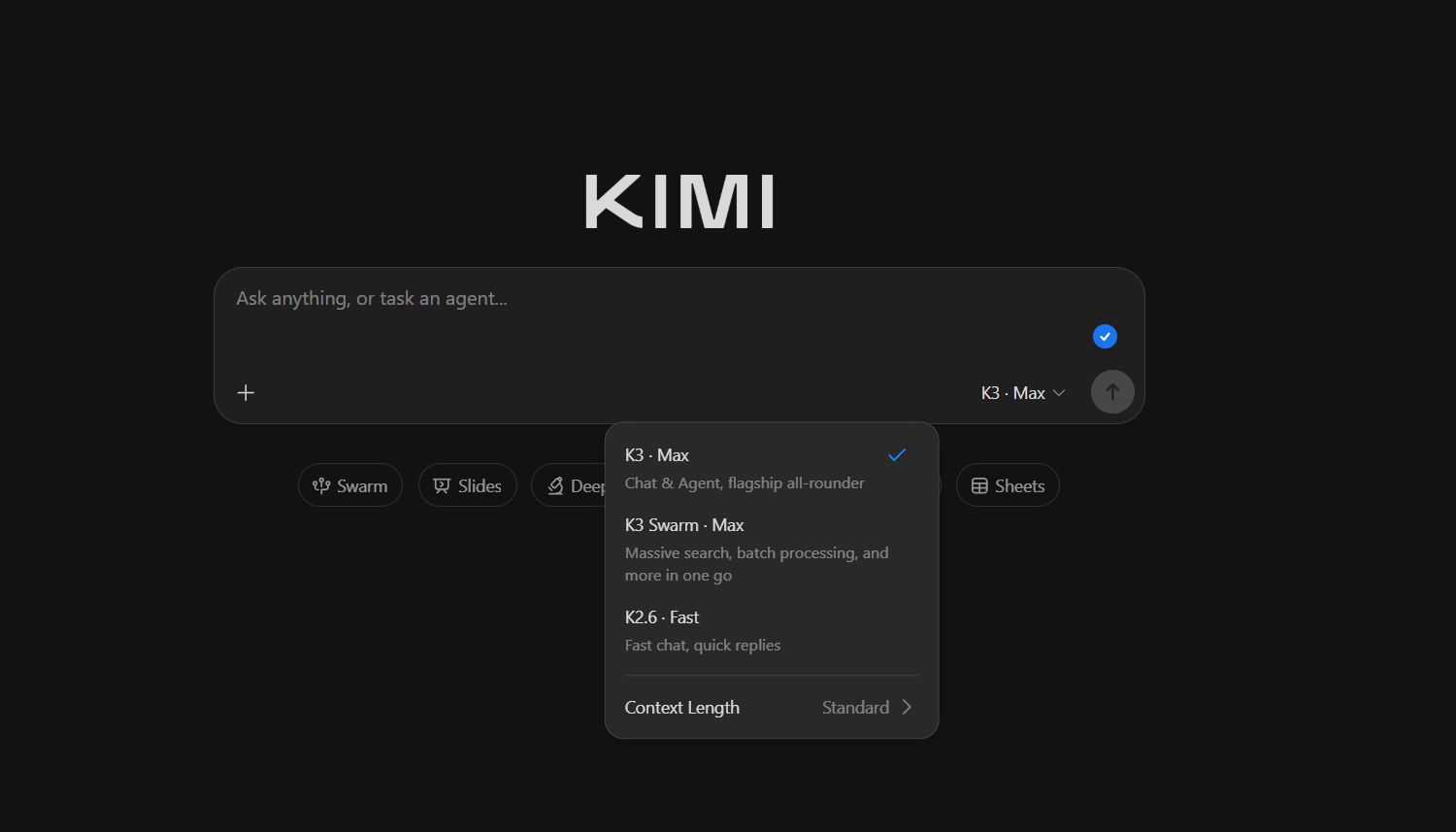
Kimi has released K3, a multimodal open-weight AI model that the company says approaches the performance of top proprietary systems while moving its pricing closer to Western frontier models. Full weights are expected by July 27, and the company did not disclose training cost, revenue impact or enterprise customer adoption.
The model is built on a mixture-of-experts architecture with 896 experts and 2.8 trillion total parameters, with 16 experts active at a time, according to Kimi. It supports image and video inputs and a one-million-token context window. Kimi describes K3 as the first open model in the roughly 3 trillion parameter class.
Benchmarks put K3 near the top tier, with caveats
In Kimi’s own tests, K3 trailed Claude Fable 5 and GPT-5.6 Sol but beat other tested systems including Claude Opus models and GLM-5.2. Kimi said the results were run at maximum or high thinking intensity. Across 35 tests, K3 ranked first about seven times and was usually second or third elsewhere, while Fable 5 had the most individual wins.
The comparison is not fully controlled. Kimi used different agent systems depending on the benchmark, including KimiCode, Claude Code and Codex, so the scores do not isolate only the base model.
Artificial Analysis, an independent testing lab, gave K3 a score of 57 on its Intelligence Index. That placed it near Claude Opus 4.8 and GPT-5.5, behind Claude Fable 5 at 60 and GPT-5.6 Sol at 59. On GDPval v2, K3 reached an Elo rating of 1,668, up from 1,190 for K2.6, ahead of GLM-5.2, GPT-5.5 and Claude Opus 4.8, but below Claude Fable 5.
Artificial Analysis also reported that K3 led AutomationBench-AA with a 53 percent score and reached an overall Elo of 1,547 on AA-Briefcase, its private long-horizon knowledge work test. The lab said K3’s accuracy on the AA-Omniscience Index rose from 33 percent to 46 percent versus K2.6, but its hallucination rate also increased from 39 percent to 51 percent.
More capable, more expensive
Kimi’s API pricing puts K3 at $3 per million input tokens without a cache hit, $0.30 with a cache hit and $15 per million output tokens, including reasoning. Those rates apply regardless of context length, according to Kimi’s platform documentation.
That is a sharp increase from K2.6, which Kimi lists at $0.95 per million uncached input tokens, $0.16 with a cache hit and $4 for output. It is also the clearest signal in this launch: Chinese frontier models are not being priced only as low-cost alternatives.
- Kimi K3: $0.30 cached input, $3 uncached input, $15 output per million tokens.
- Kimi K2.6: $0.16 cached input, $0.95 uncached input, $4 output per million tokens.
- Claude Sonnet 5: $0.30 cached input, $3 uncached input, $15 output per million tokens.
- Claude Fable 5: $1 cached input, $10 uncached input, $50 output per million tokens.
- GPT-5.6 Sol: $0.50 cached input, $5 uncached input, $30 output per million tokens.
Artificial Analysis estimated K3’s average cost at $0.94 per Intelligence Index task, close to GPT-5.6 Sol at $1.04 and below Claude Opus 4.8 at $1.80. It remains more expensive than open-weight peers cited by the lab, including GLM-5.2 at $0.32 and DeepSeek V4 Pro at $0.04.
Kimi is pitching K3 at long-running agents
Kimi says K3 is designed for extended software development work, including codebase analysis, terminal tool use and multi-step tasks with limited human involvement. The company also says its “Vision in the Loop” approach lets the model inspect visual output, change code and evaluate the result, a workflow it is positioning for UI, game and CAD-related work.
Kimi showed browser-based demos including a 3D open-world game built with Three.js, WebGPU and GPU Compute, as well as a black hole visualization, a Long March 10 rocket simulation and a Game Boy Advance emulator. For the open-world demo, Kimi said K3 generated the environment and used an external tool for the rider and horse models.
K3 is available through Kimi.com, Kimi’s mobile apps, Kimi Work desktop version 3.1.0 and later, Kimi Code and OpenRouter under “moonshotai/kimi-k3,” where it is currently served only through Moonshot itself. Kimi also offers a business version with member management and separated personal and work accounts, and is taking waitlist sign-ups for Kimi Hosted Agent, a planned platform for isolated long-running task environments.
This story draws on original reporting from The Decoder.