Intel expands Google Cloud deal to use Gemini in chip development
Intel plans to deploy Gemini Enterprise across its workforce and use Google Cloud capacity for silicon simulations, with no deal value or performance targets disclosed.
By Dominic Okoye · Staff Writer
· 3 min read
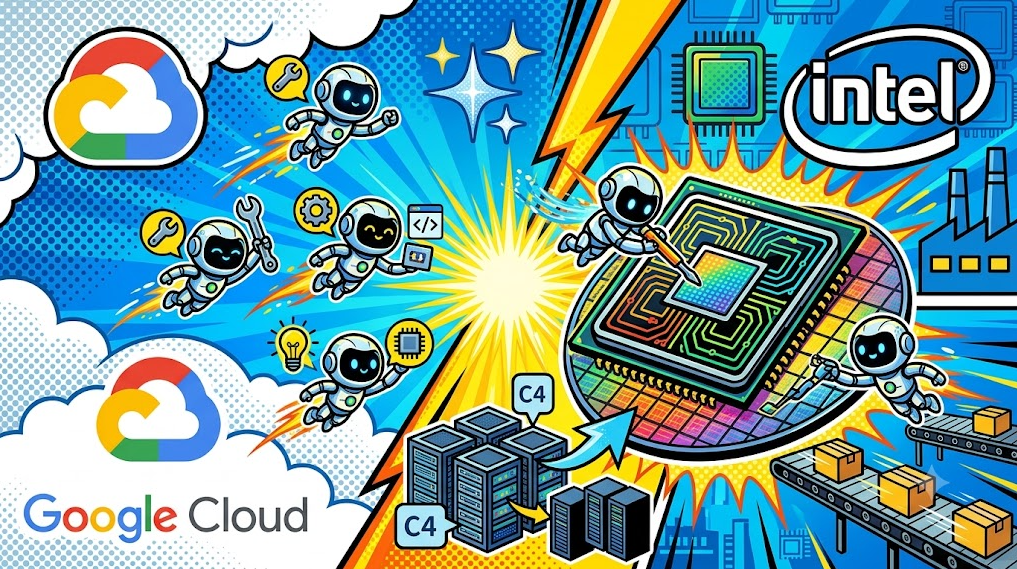
Intel is expanding its Google Cloud relationship by rolling out Gemini Enterprise across its global workforce and using Google’s AI agents in parts of its chip development process. The companies did not disclose a contract value, deployment timeline, headcount affected, or quantified targets for productivity or design-cycle improvements.
The chipmaker said Gemini Enterprise will be used across corporate functions, engineering, supply chain, marketing and communications. Intel framed the move as a shift away from scattered AI pilots toward broader internal use of agentic tools, including coding assistance and engineering automation.
Cindy Stoddard, Intel’s vice president and chief information officer, said the company wants employees to work faster and use Gemini Enterprise as a hub for building and deploying agents. Intel also said Google Cloud’s infrastructure will support its silicon development work alongside Intel’s own on-premises compute capacity.
The technical claim is centered on chip design simulations and developer workloads. Intel said it plans to use Google Cloud C4 and N4 instances to run multiple high-performance computing simulations at the same time. The company said that additional capacity should help shorten chip design work, but it did not provide baseline simulation volumes, cycle times, cost assumptions or benchmarks for comparison.
Intel said the Gemini deployment will include customized line-of-business agents trained around its internal processes. Those agents are expected to handle multistep workflows that are currently manual, according to the company. The announcement did not specify which workflows would be automated first, how outputs would be verified, or how Intel will handle engineering-risk controls in silicon design.
Marketing and communications teams are also in scope. Intel said early Gemini pilots include agents that help identify relevant subject-matter experts for a topic and prepare executive-level messaging. The company also said the tools could generate more targeted content for particular audiences.
The broader context is a two-way infrastructure relationship between Intel and Google. The companies have previously worked together on AI chip interconnects and 5G network initiatives. In April, Google said it would adopt multiple future generations of Intel Xeon processors for Google Cloud, covering AI and general-purpose workloads. That arrangement also included Intel infrastructure processing units, which offload infrastructure management work from CPUs.
That earlier Xeon commitment is relevant to the new cloud story. Constellation Research analyst Holger Mueller told SiliconANGLE that Intel’s use of Google Cloud and Gemini makes sense, while also noting that some observers may view the arrangement as a reciprocal deal because Google Cloud’s C4 and N4 instances run on Intel Xeon processors. His view was that the arrangement is acceptable if customers benefit.
Google Cloud Chief Product and Business Officer Karthik Narain said the combination of Intel engineering and Google Cloud’s agentic AI tools will accelerate how Intel designs and operates for AI-related demand. That is the vendor case. The harder measure will be whether Intel can show shorter design loops, lower simulation bottlenecks or fewer manual engineering steps, none of which were quantified in the announcement.
This story draws on original reporting from SiliconANGLE.