Republic Europe shifts focus to late-stage secondary deals
The investment platform is pitching WHOOP secondaries as private companies stay private longer, but it did not disclose allocation size, fees or buyer pricing.
By Dominic Okoye · Staff Writer
· 3 min read
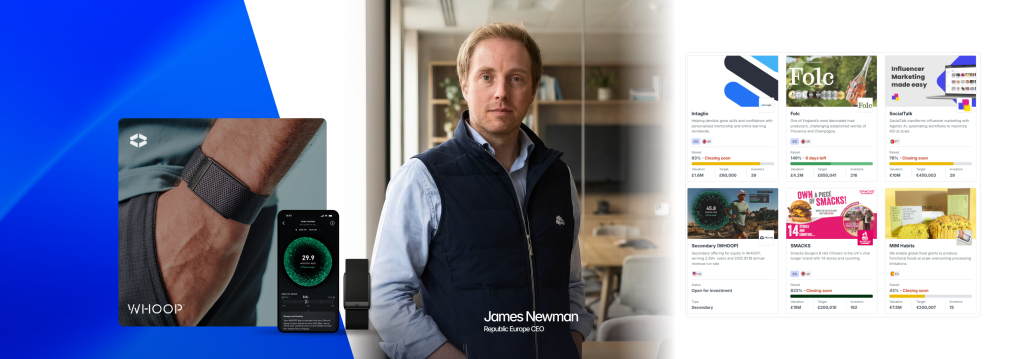
Republic Europe is putting more of its effort behind late-stage secondary offerings, using a current WHOOP campaign to pitch individual investors access to shares in mature private companies. The platform did not disclose the size of the WHOOP allocation, buyer pricing, fees or expected participation, leaving the economics of the campaign unclear.
The push was outlined by James Newman, Republic Europe’s CEO and EVP of global operations, in a paid Republic-produced post published by Sifted. Newman argued that private companies are capturing more of their growth before public listings, limiting the upside available to public-market buyers at IPO.
Republic’s case rests on a broad shift in capital markets. Newman said private markets now represent nearly 9% of global equities, compared with about 2% a decade ago. He also pointed to SpaceX’s Nasdaq debut, which he described as the largest IPO in history and said ended its first trading day at a roughly $2 trillion valuation, as an example of a company that created most of its value before public investors could buy shares.
WHOOP is the current test case
Republic Europe is using WHOOP as its live example of the model. The company is offering access through a structured secondary allocation, according to Newman, rather than through a primary fundraising round or a public listing.
WHOOP sells subscription-based fitness and health hardware. Republic described the company as operating across AI, predictive health and elite performance, categories that carry investor appeal but often come with broad positioning. The disclosed operating figures are more concrete: Newman cited WHOOP reporting that showed the company was cash-flow positive at the end of 2025, had a $1.1 billion annual revenue run rate, and recorded 103% year-on-year growth in subscription bookings.
WHOOP also closed a $575 million Series G in March 2026 at a $10.1 billion valuation, according to Newman. Republic did not say whether the secondary campaign is priced at that valuation, above it or below it.
Liquidity remains the unresolved question
Republic is also tying the late-stage push to its secondary trading platform. Newman said the company wants to pair company-led campaigns with a 24/7 marketplace so investors have potential liquidity before an IPO or acquisition.
The company named WHOOP, SpaceX and Kraken as examples of companies that later-stage participants may be able to access through transactions between willing buyers and sellers. Republic also acknowledged that liquidity is not guaranteed and that no platform can promise a buyer.
That caveat matters. Secondary markets can shorten holding periods, but they do not remove core private-market risks: limited information, uncertain pricing, transfer restrictions and dependence on buyer demand. For late-stage companies, the diligence emphasis changes toward valuation, unit economics, retention behavior and growth durability, according to Newman.
Republic Europe is scheduled to host an investor webinar on 16 July covering how secondary markets work, how company-led campaigns are structured and what participants should consider before joining offerings such as WHOOP. The broader signal is clear enough: platforms that began by widening access to early-stage startup rounds now want to intermediate the much larger pool of pre-IPO stock in companies that are delaying public listings.
This story draws on original reporting from Sifted.