Kausable raises €12 million seed round for causal reasoning AI
UVC Partners and Entourage led the European AI lab’s seed round as it tries to reduce retraining costs for frontier models.
By Dominic Okoye · Staff Writer
· 3 min read
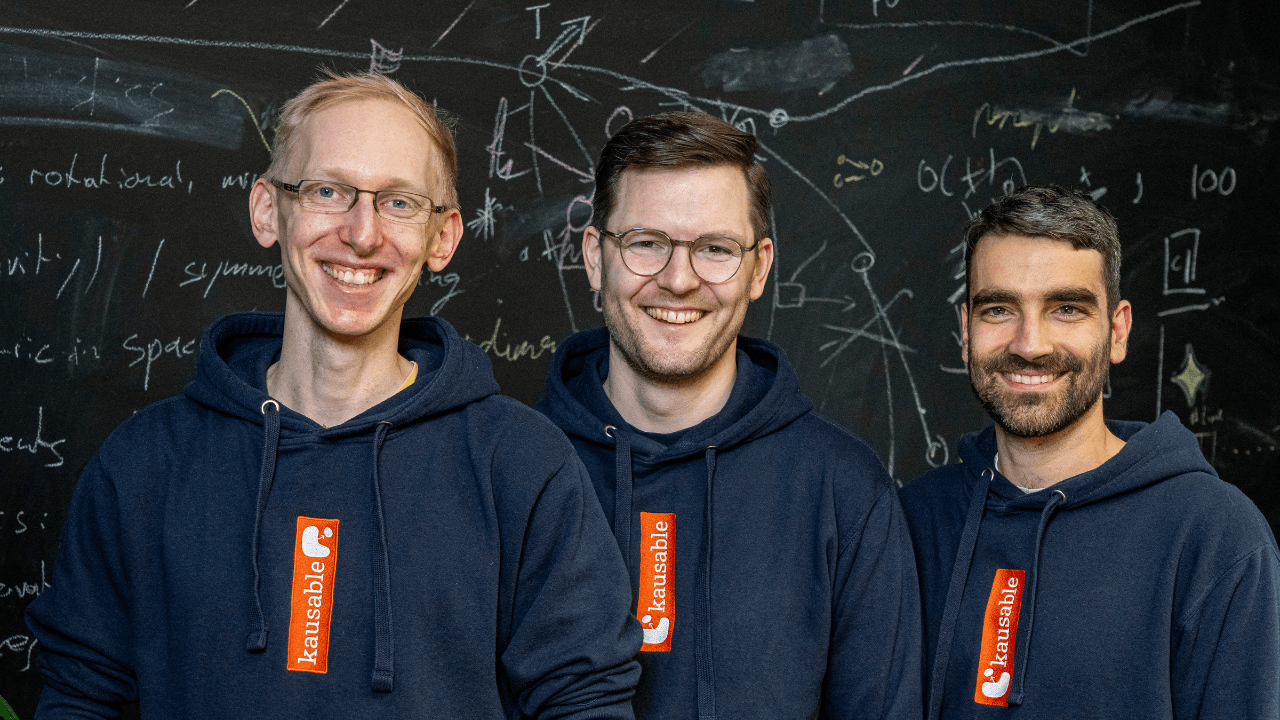
Kausable has raised €12 million in seed funding to build AI models that, according to the company, can adjust to new conditions without repeated retraining. The round was led by UVC Partners and Entourage, with returning backing from HTGF and Mätch VC. The company did not disclose a valuation, revenue, customer count or commercial contract terms.
The European AI lab is working on what it describes as reasoning-first frontier AI, a category claim centered on causal models rather than larger text-trained systems. The pitch is that models can learn from a small number of examples and transfer that learning across settings, reducing the cost and data burden associated with updating AI systems when environments change.
Kausable was founded in 2025 by Johannes Haux, Dr Benjamin Herdeanu and Gregor Ramien, based on research at Heidelberg University and experience in startups, cybersecurity and banking. The company began developing the concept in 2024, incorporated in early 2025, participated in the Startup BW Pre-Seed programme and previously raised about €1.5 million in pre-seed capital.
Backers from AI and academia
The seed round adds to a cap table that includes private angel investors from Black Forest Labs, OpenAI, Google DeepMind, Noxtua, ELLIS and other AI and technology organizations. Named angels include Black Forest Labs co-founders Robin Rombach and Andreas Blattmann, OpenAI’s Sandro Gianella, DeepMind strategic adviser Dorothy Chou, former Robert Bosch board member Dr Michael Bolle, IONOS CPO Dr Andreas Nauerz and ELLIS co-founder Prof Dr Matthias Bethge.
The company also has ties to Heidelberg University and Black Forest Labs, one of Germany’s best-known AI companies. Kausable is positioning the financing against a broader European push for digital sovereignty, although the company has not disclosed whether any government, defense or public-sector customers are involved.
A causal model bet
Kausable says its system uses a “world model” built from causal relationships. Instead of continuously changing a model’s internal weights when conditions shift, the company says it trains a foundation model once and then adapts it to new tasks with a limited set of examples.
Haux has argued that conventional AI often needs large datasets and retraining when operating conditions change, while Kausable’s Bayesian approach improves as it receives new evidence. Ramien has said the company’s models learn from abstract cause-and-effect structures rather than inferring behavior from large volumes of language data.
The team has co-authored a research paper with experts from Columbia University on the causal reasoning architecture behind the model. Kausable says it trains on synthetic causal data, which it claims can reduce reliance on customer data and give the company more control over the types of systems its models learn to represent. Those claims remain early-stage commercial assertions, with product adoption still to be proven.
Early applications and hiring plans
One demonstration is TipPFN, described by Kausable as a zero-shot forecasting model for complex dynamic systems. Herdeanu has said the model was tested across 15 domains, including ecological systems, biomedical data and energy infrastructure, with examples such as seizure prediction from EEG data and anticipating electrical grid blackouts. The company says the model learned from only a small number of examples.
Kausable sees potential applications in healthcare, robotics, forecasting and industrial systems. Physical AI is a stated priority because robots often face new situations and training data can be difficult to collect. Herdeanu has also pointed to demand forecasting as an area that may be easier to commercialize earlier while the broader platform matures.
The company says it remains primarily research-oriented and plans to become more product-focused over the next year through customer pilots. Kausable will use the new capital to expand its nine-person team and continue developing its rapid-learning frontier model.
This story draws on original reporting from Tech.eu.