Walden Robotics raises $300 million seed at $1.1 billion valuation
The Toyota Research Institute spinout says its humanoid robots are already working eight-hour shifts inside a Toyota plant in North America.
By Ingrid Halvorsen · Venture Capital Reporter
· 3 min read
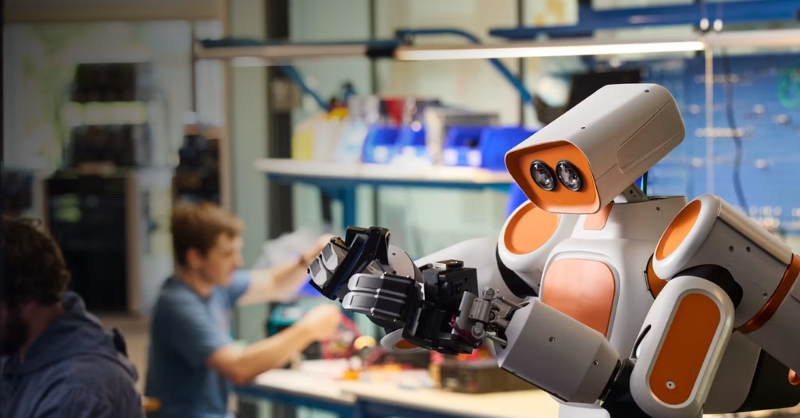
Walden Robotics has come out of stealth with a $300 million seed round at a $1.1 billion valuation, co-led by Toyota-linked investors and Deviation Capital. The Cambridge, Massachusetts startup is notable for claiming live factory deployment now: its wheeled, upper-body humanoid robots are already working eight-hour shifts in a Toyota plant in North America.
The financing was co-led by Toyota Motor Corp., Toyota Invention Partners and Toyota Ventures, alongside Deviation Capital. Other investors include NVIDIA, Boeing, AE Ventures, Samsung Ventures, Prologis Ventures, CoreWeave Ventures, Calibrate Ventures, Colle Capital, Shine Capital, NextView Ventures, Squarepoint Capital, One Madison Group, KAS Venture Partners and Menlo Ventures. Walden did not disclose revenue or headcount.
Walden says its robots are handling manufacturing and logistics work including loading and unloading car parts, cleaning machinery and preparing component kits for assembly. The machines operate alongside human employees, according to the company, rather than in a separate demonstration setting.
Built out of Toyota research
Walden was founded in 2026 by robotics and AI veterans from Toyota Research Institute, MIT, Stanford and Amazon. Co-founder and CEO Russ Tedrake is an MIT professor and Toyota professor of electrical engineering and computer science. He previously spent a decade at Toyota Research Institute, most recently as senior vice president of large behavior models.
The company spun out of Toyota’s research operation in January and says its robots were in production inside a Toyota factory by February. That timing is central to the pitch. Much of the humanoid robotics market has been built around controlled demos and pilot programs; Walden is presenting factory output as its early proof point.
Walden’s software work centers on large behavior models, a class of AI models designed for physical tasks. The company says the approach lets robots improve through repeated real-world work instead of requiring manual reprogramming for each new job. Conventional industrial robots can take weeks to reprogram for new tasks; Walden says it is trying to reduce that process to days.
Tedrake said advances in what he called physical AI have made the company’s approach possible, but added that progress depends on building with people who understand how factory floors operate. Toyota Motor Corp. executive vice president and chief technology officer Hiroki Nakajima said Toyota and Walden share an emphasis on robots that keep improving while keeping people central to the work.
A crowded humanoid robotics market
The round lands during an expensive cycle for robotics companies that want to automate repetitive physical labor. Grand View Research estimated the global industrial robotics market at about $18.5 billion in 2025 and projected it would exceed $44 billion by 2030, driven by labor shortages, aging workforces and lower-cost AI automation.
Capital has also flowed into humanoid and adjacent robotics companies. Skild AI raised $1.4 billion to develop a robot-agnostic foundation model. Apptronik closed a $520 million extension for its Apollo robot. Germany’s NEURA Robotics raised $1.4 billion. Figure AI raised more than $1 billion in a Series C at a $39 billion valuation in September 2025, while Agility Robotics raised $400 million at a $1.75 billion valuation and later agreed to go public through a SPAC merger.
Walden is taking a different line from companies focused mainly on robot hardware platforms or general models for many robot bodies. Its claim is that deployment inside a working factory gives it data and customer credibility earlier than many peers. That claim still depends on whether the robots perform outside a Toyota setting.
The company says the seed capital will fund product development, manufacturing capacity and commercial expansion beyond Toyota. Target sectors include aerospace, semiconductors, electronics, logistics and life sciences, where Walden says it already has strategic partners.
This story draws on original reporting from TechFundingNews.