Microagi raises $55 million seed round for factory robotics software
The Munich startup says its Hummingbird-led round is Germany’s largest seed financing; its valuation and revenue were not disclosed.
By Ingrid Halvorsen · Venture Capital Reporter
· 3 min read
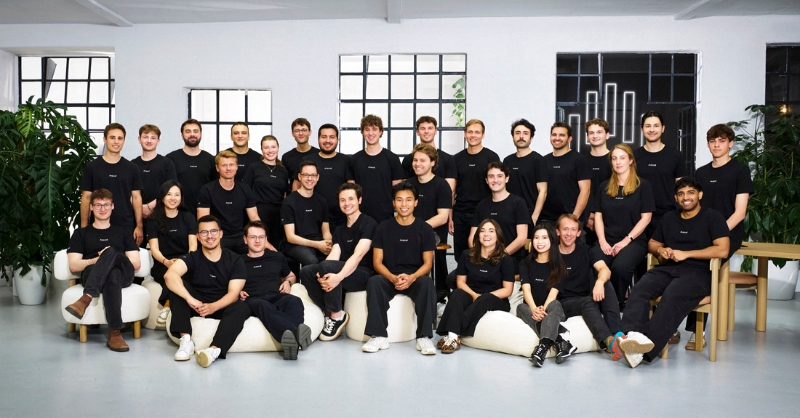
Munich robotics startup microagi raised $55 million in a seed round led by Hummingbird Ventures to commercialize software that adapts robots to specific factory tasks. The company says the financing is the largest seed round in German history, a notable claim in a European robotics market trying to close a deployment gap with China.
Northzone, LocalGlobe, Village Global and redalpine also participated. microagi did not disclose its valuation, revenue, ownership terms or the size of its earlier pre-seed round.
The company was founded in September 2025 and closed the seed less than a year later. Its five co-founders are Bercan Kilic, formerly an aerodynamics engineer at Red Bull Racing and a professional esports player; Yoan Iliev, previously at Mercedes-AMG Petronas F1; Anton Poletaev, a former Alan Turing Institute researcher; Nico Nussbaum, an engineer from RWTH Aachen; and Artjem Weissbeck, co-founder of WhatsApp commerce platform Charles.
Atlas targets factory reliability, not robot hardware
microagi’s main product is Atlas, a platform the company says is built to solve the reliability gap between robotics demonstrations and unattended production work. Atlas gathers data from factory operations through cameras and sensor-equipped gloves, rebuilds those working conditions in simulation, and tunes existing AI foundation models for plant-specific tasks.
The company says its engineers then deploy robots at customer sites and feed the results back into later training runs. microagi is not building robots or foundation models itself. It describes Atlas as hardware- and model-agnostic, with partners including Unitree and NVIDIA.
The bet is that many robotics deployments fail less because of mechanical capability than because of missing local data. According to microagi’s pitch, a robot can reach about 95% task reliability and still be unusable without training on the edge cases that occur in a specific factory. The company did not name paying industrial customers or disclose deployment volume.
Consumer data collection sits alongside the industrial product
microagi also operates a consumer-facing unit called shift, which collects first-person task footage for robot training. In New York City, the app offered free professional apartment cleanings if cleaners wore head-mounted cameras while working. The company says the footage is anonymized before use.
The first 250 New York cleaning slots were taken immediately, according to microagi. The company later expanded shift to offer private chefs in San Francisco, with London, Munich and Zurich planned next.
microagi says shift now has more than 10,000 operators across 15 countries and that they earned more than $5 million collectively in the first quarter of 2026. Operators are paid around $20 an hour, according to the company. microagi employs 37 people, while shift has about 75 staff.
Europe’s robotics gap frames the funding
The round lands against weak European robot installation numbers. Europe installed 85,000 factory robots in 2024, compared with 295,000 in China. The demographic pressure is also explicit in microagi’s messaging: nearly 40 million EU workers are over 55, the EU median age reached 44.9 in 2025, and the European Commission estimates the bloc could lose 18.8 million workers by 2050.
Kilic has argued that European manufacturers have a short window to build a robotics advantage before experienced workers retire. That is a projection tied to labor supply rather than disclosed customer demand.
The company said the new capital will support Atlas deployments with global manufacturers, expansion of the shift data network, a U.S. presence based in New York, and a research headquarters in Zurich, which it chose over San Francisco because of local robotics talent.
microagi enters a well-funded field. Grand View Research estimated the industrial robotics market at about $18.5 billion in 2025 and projected it to exceed $44 billion by 2030. PitchBook put global robotics funding at $27.6 billion in 2025, up 101% year over year. Nearby competitor NEURA Robotics raised a Series C of up to $1.4 billion in June, while Figure AI, Skild AI and Physical Intelligence have also raised large rounds for robotics and embodied AI.
This story draws on original reporting from TechFundingNews.