Meshy AI 3D platform expands from creator app to enterprise workflows
Meshy says its 3D creation tools now span Workspace 3.0, APIs and 3D printing integrations, with 10 million users claimed.
By Marcus Adeyemi · Startups Editor
· 3 min read
Meshy AI is positioning the Meshy AI 3D platform as enterprise infrastructure after starting as a consumer-friendly text-to-3D creation tool. The Silicon Valley startup has not disclosed revenue, valuation, headcount or a new financing round, but says its product is now used across developer, design, education, manufacturing and enterprise workflows.
The company was founded in 2023 by CEO Ethan Hu, described by Meshy as an MIT Ph.D. graduate and the inventor of the Taichi GPU programming language. Meshy says more than 10 million users have created 100 million 3D models on its service, a scale claim that points to demand for faster asset generation but does not show how much of that activity is paid usage.
What does Meshy AI do?
Meshy lets users generate 3D assets from text prompts, reference images or descriptions, then export those assets into standard production formats. The company says the platform can produce geometry, textures and optimized files for tools including Unity, Unreal Engine, Maya and Cinema 4D.
The product set now includes text-to-3D, image-to-3D, AI texture generation, auto-rigging, animation, remeshing and retopology. Meshy says exported formats include GLB, FBX, OBJ, STL, USDZ, 3MF and Blender files, which matters for teams that need AI-generated assets to fit into existing pipelines rather than remain inside a single app.
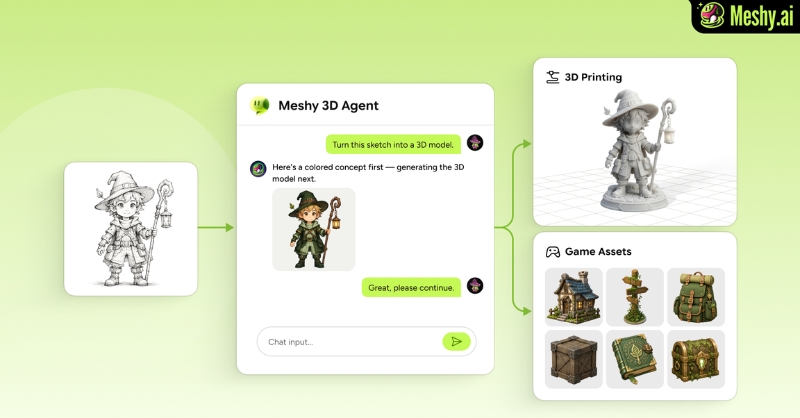
The company is also developing Meshy 3D Agent, a conversational creation interface. According to Meshy, users can provide an image, sketch, rough idea or spoken input, then refine design concepts through dialogue before receiving downloadable 3D geometry.
How is Meshy AI moving into enterprise use?
The clearest enterprise push is Workspace 3.0, which Meshy describes as a shift from asset generation toward project-based production. The workspace combines image generation, modeling, animation and printing in shared project areas with asset libraries and API endpoints.
That is the part of the product aimed at teams rather than individual creators. For enterprises, the question is less whether a model can be generated quickly and more whether assets can move through approval, editing, integration and deployment without adding another disconnected tool to the stack.
Meshy is also tying its software to 3D printing and manufacturing workflows. The company says its FlashForge implementation allows designs to be created in Flash Studio and sent to compatible printers, including automatic texture-to-filament color generation. A Bambu Lab integration adds one-click printing and compatibility work for character and figure models, according to Meshy. Its Formlabs partnership connects AI-created models to SLA and SLS printing through a service bureau.
Meshy says xTool and Snapmaker are building custom creative experiences using its API. Those integrations give the company a distribution path outside its own interface and suggest it is trying to become a layer other hardware and creative-tool vendors can build on. That is a familiar move for startups trying to prove demand is pulling the product, though Meshy has not provided customer revenue or retention data.
Where is Meshy being used?
Meshy cites examples across games, education, cultural projects and tabletop design. The company says the developer Jlemarchand used Meshy to create character art for Navy Island Confidential, while horror game creator EvilKris used Meshy 3D agents to iterate on monsters for Famished.
Other examples include cyber_fox using Meshy assets for an English learning app and reporting a reduction from roughly 300 hours in Blender for a character silhouette to about five minutes per model. Meshy also says Teacher Noel used the platform in VITA School’s eighth-grade game design class, where students created and imported Roblox-ready assets, and 85% described the tool as more intuitive than expected.
The broader bet is that 3D creation will move beyond specialist modeling teams as more products need interactive assets, product visualizations, digital twins and printable models. Meshy has supplied adoption figures and integration claims, but the commercial weight of the platform will depend on paid enterprise usage, workflow lock-in and whether AI-generated 3D assets meet production standards at scale.
This story draws on original reporting from TechFundingNews.