Hyundai buys SoftBank’s remaining Boston Dynamics stake
Hyundai will take full control of Boston Dynamics in a roughly $325 million deal as it prepares to put Atlas robots into its own factories.
By Marcus Adeyemi · Startups Editor
· 3 min read
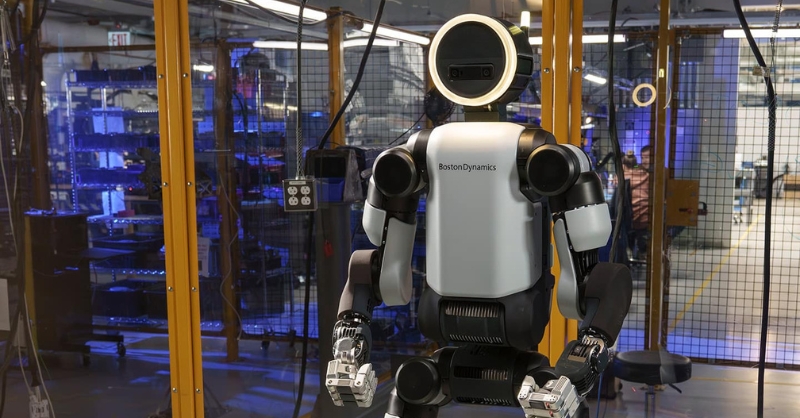
Hyundai Motor Group has agreed to buy SoftBank’s remaining 9.65% stake in Boston Dynamics for an estimated $325 million, giving the automaker full ownership of the robotics company. The deal matters less as a financial exit for SoftBank than as a signal that Hyundai wants tighter control over the path from humanoid prototype to factory deployment.
The purchase uses a put option set when Hyundai acquired an 80% position in Boston Dynamics in 2021. The new transaction implies a valuation above $3 billion for the maker of the Atlas humanoid robot and the Spot quadruped inspection robot, nearly triple the valuation attached to Hyundai’s original deal five years ago. Boston Dynamics revenue figures were not disclosed.
Hyundai wants the robots and the factories
Hyundai has described the move as part of its Physical AI strategy, combining Boston Dynamics’ robotics work with Hyundai’s manufacturing base and AI capabilities. That positioning is broad, but the concrete plan is specific: Hyundai intends to begin using production versions of Atlas at its electric vehicle plant in Georgia in 2028.
The initial work is expected to cover logistics and heavy lifting. By 2030, Hyundai plans for Atlas robots to move into welding and component assembly. The company is targeting annual production capacity of 30,000 humanoid robots, with more than 25,000 slated for use across Hyundai and Kia plants and the rest intended for commercial sales.
That makes Hyundai different from robotics startups that must persuade manufacturers to let early systems onto production lines. Hyundai owns the deployment environment, which could shorten feedback loops and give Boston Dynamics access to manufacturing data from real operations rather than pilots alone.
SoftBank shifts away from a single robotics bet
SoftBank’s sale is not being framed as a retreat from robotics. It comes as the Japanese investment group is reportedly preparing Roze AI, a publicly listed company that would combine robotics, AI infrastructure and data center assets, following acquisitions including ABB Robotics.
The strategy described around Roze AI is broader than ownership of one hardware company. SoftBank appears to be building around industrial AI infrastructure, including robotics, compute and automation assets. That is a different bet from holding a minority stake in Boston Dynamics while Hyundai controls the company’s commercial direction.
Grand View Research estimates that the industrial robotics market was worth about $33.9 billion in 2024 and projects it will reach $60.6 billion by 2030. The firm cites AI, labor shortages and factory automation as drivers. Those projections do not guarantee adoption, but they explain why capital is moving from demos toward systems that can be installed, maintained and measured in operating environments.
Humanoid robotics is getting crowded
Hyundai is entering a field with well-funded rivals. Figure AI has been valued at around $39.5 billion while pursuing humanoid robot production for manufacturing. Skild AI recently raised $1.4 billion to build foundation models for multiple robot types. Walden Robotics came out of stealth with $300 million for general-purpose industrial robots.
In Europe, microagi raised $55 million for software intended to help manufacturers integrate robots into production, while NEURA Robotics raised $1.4 billion to expand its humanoid robotics platform.
The Boston Dynamics deal shows two capital strategies forming in Physical AI. Hyundai is betting that owning the robot maker and the factory floor creates an advantage. SoftBank is moving toward the infrastructure layer that could support many robots and automation systems. The market will judge both approaches on deployments, uptime and cost, not on humanoid demos.
This story draws on original reporting from TechFundingNews.