Humanoid raises $152 million at $1.35 billion valuation
The London robotics startup says it has $2.4 billion in pre-orders, but it has not shipped commercial robots or disclosed revenue.
By Marcus Adeyemi · Startups Editor
· 3 min read
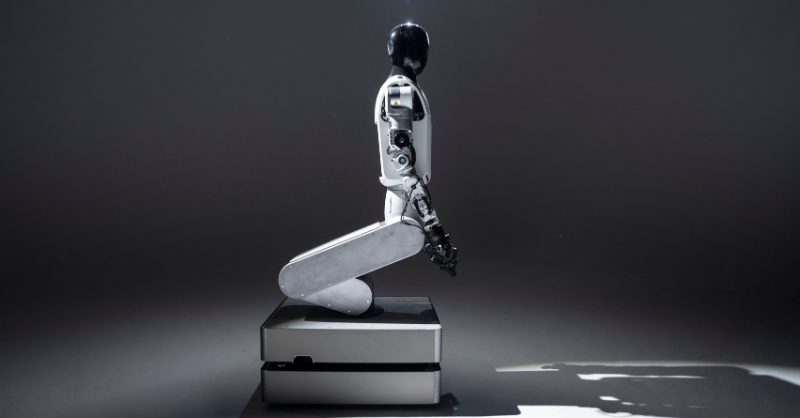
Humanoid has raised $152 million at a $1.35 billion valuation, giving the two-year-old London robotics startup $270 million in total funding since 2024. The round adds another high-priced European entrant to the humanoid robotics market, where investor expectations are running well ahead of disclosed revenue.
Prime Movers Lab led the financing. The firm previously backed Figure AI, which reached a reported $39 billion valuation. Bosch, Schaeffler, Fubon Financial Holding Venture Capital and Aglaé Ventures, the investment firm tied to Bernard Arnault’s family, also participated.
Humanoid says it has 34,000 robot pre-orders representing $2.4 billion in value. The company has not shipped commercial units and did not disclose revenue, deposit terms, cancellation provisions or customer names tied to those orders.
Industrial investors move closer to production
Bosch’s involvement goes beyond the cap table. Humanoid said Robert Bosch Robotics GmbH will serve as its contract manufacturer and provide support on hardware design, production and supply chain work. That gives the startup a manufacturing partner with industrial scale, a useful distinction in a category where prototypes are easier to show than fleets are to build and maintain.
Schaeffler also framed its investment as strategic and commercial. The supplier’s participation, along with Bosch’s role, suggests Humanoid is positioning first around industrial deployment rather than consumer-facing robotics.
The new capital will be used to develop Humanoid’s next robotics platform, begin mass production of its wheeled robots and continue work on KinetIQ, the company’s in-house AI system. Humanoid said the longer-term target markets are logistics, manufacturing and retail.
A fast buildout, with self-reported milestones
Humanoid was founded in London in May 2024 by Artem Sokolov, who reportedly put $30 million of his own capital into the company at launch. Sokolov previously sold his family’s manufacturing business in August 2025 after scaling it to $1 billion in revenue over more than a decade, according to the company’s account.
The startup has offices in London, Boston and Vancouver and employs between 51 and 200 people. Its current platform, HMND 01, includes wheeled and bipedal humanoid robots. Humanoid says it produced a wheeled alpha robot in seven months and a bipedal version in five months, compared with what it describes as an 18-to-24-month industry norm. Those development timelines are company claims and have not been independently verified.
A beta version is planned for the fourth quarter of 2026. The company’s main product at present is a wheeled robot, while better-funded U.S. and Chinese rivals have emphasized bipedal designs.
The unicorn claim needs context
Humanoid describes itself as Europe’s first pure-play humanoid robotics unicorn, a claim that depends on definitions. Germany’s Neura Robotics raised a Series C round of up to $1.4 billion in June 2026 and is reportedly valued at about $7 billion, with backing from Tether, Nvidia, Amazon and Qualcomm. Barcelona-based THEKER also raised an $85 million Series A in June 2026 with investors including LVMH.
Outside Europe, Humanoid remains far smaller than the category’s highest-valued private companies. Figure AI has been valued at $39 billion, while Austin-based Apptronik raised $520 million in February 2026 at a reported valuation between $5 billion and $5.5 billion.
Goldman Sachs has projected the global humanoid robot market could reach about $38 billion by 2035. Current private-market valuations already press against that forecast, leaving execution, manufacturing yield and real customer deployment as the tests that will matter more than prototype speed.
This story draws on original reporting from TechFundingNews.