HTGF’s Family Day turns Germany revival talk into startup meetings
High-Tech Gründerfonds’ Berlin event put life sciences, chemistry and deep-tech founders in front of corporates and investors for structured follow-ups.
By Marcus Adeyemi · Startups Editor
· 3 min read
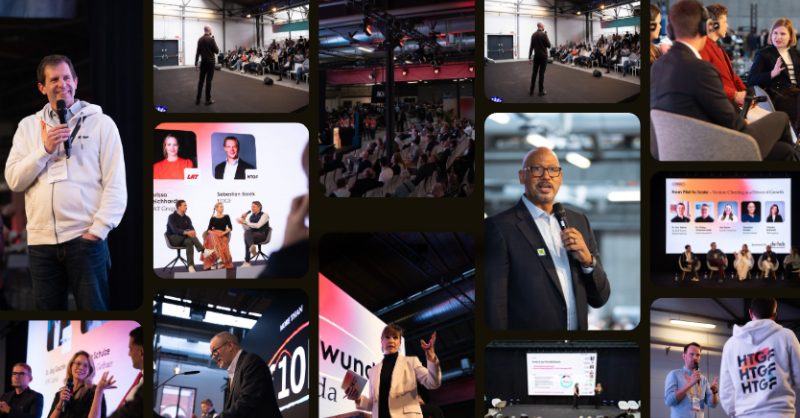
High-Tech Gründerfonds brought portfolio founders, corporate partners and outside investors to Berlin for its annual Family Day, a two-day event built around scheduled meetings rather than only stage programming. No financing round or valuation was announced; the event matters as a signal of how Germany’s public-growth narrative is being translated into private-sector startup work.
The theme was “New Wirtschaftswunder,” a reference to West Germany’s postwar industrial recovery and export rise. The framing followed a main-stage debate on whether a comparable revival is possible now and whether it can be planned. Away from the stage, the practical version was narrower: one-on-one meetings, product-trial discussions and follow-up investor conversations in life sciences, chemistry and deep tech.
Corporates remain central to the model
Dr. Nikolaus Raupp, a partner in HTGF’s Life Science and Chemistry Investment Team, described Family Day as a visible marker of progress in the sector. He argued that public money and venture capital alone are insufficient in areas such as life sciences and chemistry, where startups often need access to corporate expertise, technical infrastructure, industrial networks and domain-specific operating knowledge.
Raupp’s point matches the structure of the event. HTGF’s role is not limited to writing early checks; it is also trying to broker contact between young companies and the industrial groups that can test, validate or eventually buy what they build. The companies discussed in the coverage did not disclose commercial terms, pilot sizes or conversion rates from meetings into revenue.
Dr. Henriette Maaß, CEO and co-founder of NanoStruct, said the gathering gave the newly added HTGF portfolio company a way to meet venture investors, corporates and other startups in one venue. NanoStruct is working on rapid bacteria detection, a category where adoption depends heavily on validation partners and sector-specific sales channels.
Linda Karger, co-founder and chief operating officer of biotech startup Primogene, pointed to the event format itself. She said the one-on-one meetings allowed more detailed conversations than group sessions, giving founders more time to discuss technical and commercial issues with potential partners.
Follow-ups, not headlines
Mevaldi chief commercial officer Kristel Ridder said the company made connections with potential partners for testing new applications and also met investors who could support future fundraising. She credited HTGF’s network with helping startups move from introductions toward implementation, while not disclosing the company’s next-round target, timing or investor names.
Philipp Arbter, co-founder and chief science officer of COLIPI, said the company connected with potential investors and expects follow-up meetings. COLIPI uses microorganisms and renewable carbon sources to make alternatives to vegetable and fossil oils. Arbter also said the company would work with other companies on possible strategies, without naming those companies or specifying whether the discussions involve pilots, supply agreements or research partnerships.
The broader macro backdrop is doing some of the work here. Economic forecasters have suggested that roughly one-half to two-thirds of Germany’s expected growth in 2026 and 2027 may come from increased public spending on defense and infrastructure rather than private demand alone. That makes the private-sector transmission mechanism more important: startup trials, corporate procurement, investor follow-through and industrial adoption.
Family Day did not prove that Germany is entering a new economic miracle. It showed the operating layer beneath that phrase: founders seeking validation, corporates looking at technologies close to their own industrial needs and investors using HTGF’s network to screen companies. For deep-tech and life-science startups, that is often where the real bottleneck sits.
This story draws on original reporting from TechFundingNews.