Etched Series C values AI chip startup at $10.3 billion
Etched raised $300 million in a Sequoia-led Series C, doubling its valuation since December as it tries to take inference workloads from Nvidia.
By Ingrid Halvorsen · Venture Capital Reporter
· 3 min read
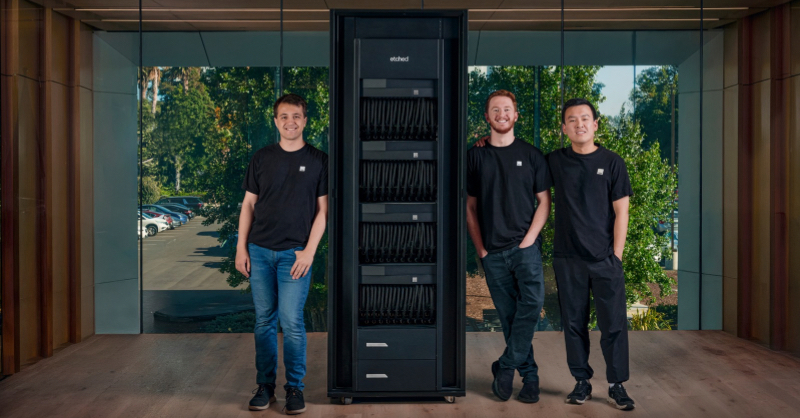
Etched raised $300 million in a Series C at a $10.3 billion valuation, giving the AI inference chip startup more capital to move from prototypes to shipments. The Etched Series C was led by Sequoia Capital and, according to Etched, marks the highest valuation yet for a Sequoia-led Series C.
The round included Andreessen Horowitz, Jane Street, Diffusion, SK Hynix, Peter Thiel and Jump Trading. Jane Street and SK Hynix are new investors, according to Etched. The company said total funding now exceeds $1.1 billion in less than four years, after a $500 million round in December 2025 valued it at $5 billion. Etched did not disclose revenue, unit shipments or named customers.
Etched CEO and co-founder Gavin Uberti said the company’s chips work, customers want them and the priority is shipping. The company’s current pitch is narrow by design: build specialized inference hardware that can compete with Nvidia’s general-purpose GPUs for AI workloads that are already moving into production.
What does Etched build?
Etched develops rack-scale AI inference clusters rather than standalone general-purpose GPU systems. Its hardware is designed to run large mixture-of-experts models such as DeepSeek and Qwen, as well as non-transformer architectures including Mamba, so buyers are not tied to a single model family.
The company points to two core technologies: Low Voltage Inference, which it says increases compute without raising energy use, and Cluster Scale Memory, which shares SRAM and HBM across a cluster. In plain terms, Etched is trying to sell a system that can run multiple model types without requiring separate GPU clusters for each workload.
That claim lands in a market with rising spending and crowded positioning. A cited market forecast expects AI inference chips to grow from $17.73 billion in 2025 to $20.51 billion in 2026, reaching $36.97 billion by 2030. Etched’s bet is that inference will be large enough, and specialized enough, to support an independent chip company despite Nvidia’s reach.
Why did Sequoia invest after passing before?
Etched was founded in 2022 by Uberti, Chris Zhu and Rob Wachen, three Harvard dropouts and Thiel Fellows. According to the company’s account, Sequoia rejected the founders’ proposal for dedicated inference silicon for years, and most large investors also passed before Primary Venture Partners and Positive Sum Ventures backed its Series A.
Sequoia entered this round after Etched’s hardware had moved beyond concept and into work with customers, according to the company. Sequoia partner Sonya Huang said the firm had studied the category for years and sees Etched as having the technical and operational requirements to define it.
Wachen, Etched’s co-founder and president, said the company is working with early customers and has more work ahead to reach “Gigawatt scale.” The company did not identify those customers or provide a timeline for broad commercial availability.
How Etched plans to use the money
Etched plans to fund an 80,000-square-foot prototyping facility in Milpitas, California, and an in-house surface-mount technology line. Those operations will sit alongside its factory in Taiwan. The San Jose-based company now has about 400 employees, up from 35 in 2024.
The competitive field has shifted quickly. Cerebras went public in May 2026 at nearly a $56 billion valuation, Nvidia bought Groq for about $20 billion in December 2025, and Microsoft-backed d-Matrix raised $275 million at a $2 billion valuation around the same period. Etched’s distinction, for now, is that it remains independent and says it supports more than ten model families.
The round gives Etched the capital to build manufacturing capacity and chase large inference deployments. The harder test is whether specialized silicon can keep pace if model architectures change faster than chip development cycles.
This story draws on original reporting from TechFundingNews.