ChipAgents Series A reaches $134 million with Micron and MediaTek backing
ChipAgents added $60 million to its Series A as the semiconductor AI startup reports 6x ARR growth and more than 120 deployments.
By Ingrid Halvorsen · Venture Capital Reporter
· 3 min read
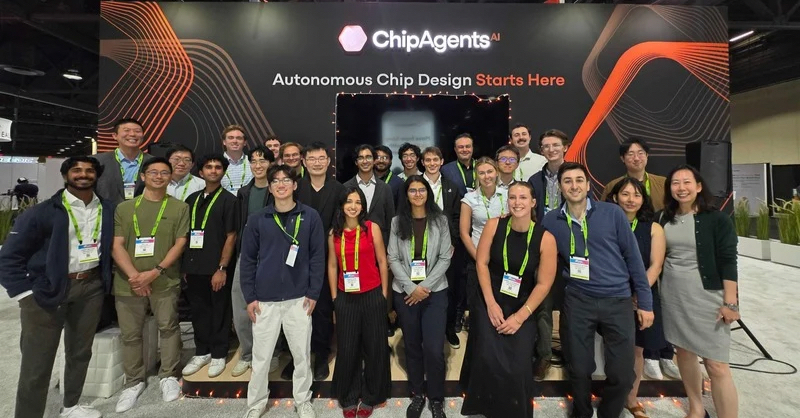
ChipAgents has extended its Series A to $134 million after adding a $60 million A2 tranche, with Micron and MediaTek backing the ChipAgents Series A while also using the startup’s software. The Santa Clara company said annual recurring revenue grew 6x in the first half of 2026, though it did not disclose actual ARR, valuation or revenue per customer.
The round adds B Capital to an investor group that includes Bessemer Venture Partners, Matter Venture Partners, Micron, MediaTek, Ericsson and ScOp. The new money comes six months after ChipAgents’ prior raise and continues a fast capital buildout for a company founded in 2024.
What does ChipAgents do?
ChipAgents builds autonomous AI agents for semiconductor design and verification. The company says its software runs inside an engineer’s code editor and can turn natural-language specifications or PDFs into synthesizable RTL, testbenches, Verilog and SystemVerilog, rather than limiting itself to code suggestions.
Founder and CEO William Wang, a UC Santa Barbara professor who previously worked on Amazon Q at AWS, has described the company’s pitch as a move from AI assistants toward agents that perform engineering tasks. That distinction is central to the startup’s positioning, since chip companies are trying to cut verification bottlenecks without increasing the risk of design errors.
ChipAgents said its platform has been deployed at more than 120 semiconductor companies. That is up from 80 in February 2026 and 50 in October 2025. Micron and MediaTek are named as both investors and customers, a useful signal in a market where strategic capital can also mean distribution, technical validation and pressure to fit existing workflows.
How fast has ChipAgents raised money?
The company has raised three disclosed Series A-related financings in less than a year. In October 2025, ChipAgents closed a $21 million Series A led by Bessemer Venture Partners, bringing cumulative funding to $24 million. In February 2026, Matter Venture Partners led a $50 million Series A1 that took total funding to $74 million.
The latest $60 million extension brings cumulative funding to $134 million. ChipAgents said the capital will be used to expand customer deployments, hire across engineering and go-to-market roles, and continue developing its AI-native design platform.
The growth claims need some framing. ChipAgents’ 6x ARR growth in the first half of 2026 sounds strong, but the company has not provided the revenue base behind that multiple. The figure is also lower than the 140x year-over-year ARR growth the company cited around its A1 financing and the 50x year-over-year growth cited at its earlier Series A, which is expected as a startup scales from a small base but still leaves investors without a clear revenue number.
Who else is building AI agents for chip design?
ChipAgents is entering a market where incumbents and startups are crowding into the same problem. Cadence acquired ChipStack and has integrated it into a ChipStack AI Super Agent tied to Cadence tools including Verisium and Cerebrus. Synopsys and Siemens EDA are also developing AI agent capabilities inside their own product suites.
Independent competitors include Bronco AI, Silimate, Verkor.io, Chipmind and Ricursive Intelligence. Verkor.io has claimed it designed a full RISC-V core from a 219-word prompt, while Ricursive raised $300 million at a $4 billion valuation based on Google AlphaChip research.
ChipAgents is selling the idea that chipmakers may want an independent automation layer rather than an agent attached to a single EDA vendor’s stack. That argument becomes harder as Cadence, Synopsys and Siemens add similar features, but strategic backing from Micron and MediaTek gives the startup more than financial endorsement. It gives ChipAgents production users in the same industry it is trying to automate.
This story draws on original reporting from TechFundingNews.