AWS introduces TorchNeuron for PyTorch workloads on Trainium
AWS has introduced TorchNeuron, a native PyTorch backend for Trainium, but its documentation lists the software as closed beta.
By Colin Brandt · Enterprise Reporter
· 3 min read
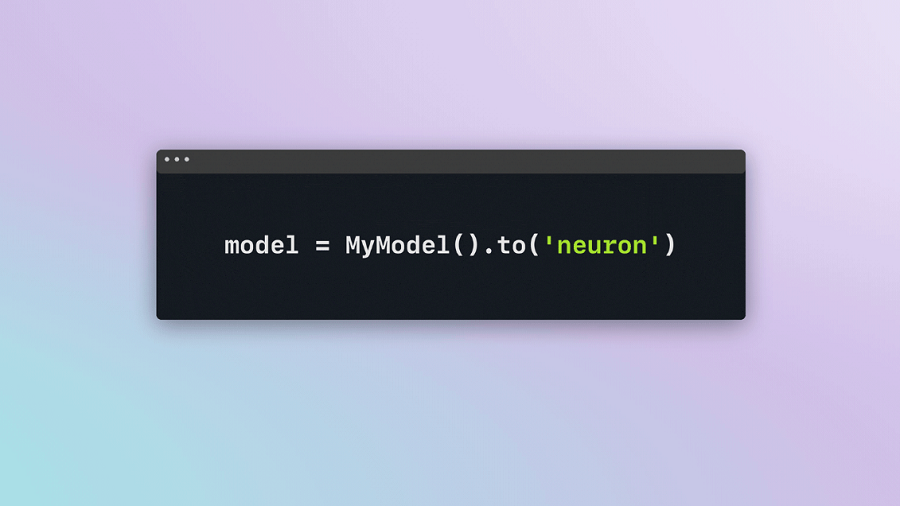
AWS has introduced TorchNeuron, an open-source native PyTorch backend intended to run PyTorch workloads on its Trainium AI chips. The AWS TorchNeuron closed beta gives selected users access to eager execution, torch.compile and distributed PyTorch APIs on Trn2 and Trn3 systems, while AWS says existing projects can move over through a configuration change rather than a code rewrite.
The software matters because hardware compatibility remains a practical constraint for teams choosing AI accelerators. TechCrunch characterized the release as an effort by AWS to address the developer-software advantage associated with Nvidia's CUDA ecosystem. That is a competitive objective, not evidence of equivalent performance or broad deployment.
Is AWS TorchNeuron generally available?
No. AWS's Neuron documentation says TorchNeuron is available only through a closed beta program and directs interested developers to contact their AWS Neuron support representative. The supplied material does not establish a timetable for wider availability, pricing, or independent performance comparisons.
AWS previously announced native PyTorch support through TorchNeuron as a private beta in its Neuron SDK 2.27.0 release in December 2025. The October 19 launch reporting describes the current offering as an open-source toolkit, but the documentation's closed-beta notice remains the relevant access constraint for customers evaluating it.
What does TorchNeuron support on Trainium?
At the standard framework layer, TorchNeuron plugs Trainium into PyTorch as a native backend. AWS documents support for eager mode, where operations run as they are called, and for torch.compile, PyTorch's compilation route. In the latter path, TorchDynamo captures PyTorch operations into graphs; the Neuron backend converts those graphs into Neuron IR, and the Neuron Compiler generates instructions for Trainium.
The backend also supports core distributed mechanisms used to spread work across sharded models. AWS lists Fully Sharded Data Parallel, Distributed Tensor, Distributed Data Parallel and Tensor Parallelism as supported. It says Pipeline Parallelism will be added later.
- Target hardware: Trn2 and Trn3.
- Workload types: training and inference, according to AWS and SiliconANGLE.
- Standard route: native PyTorch execution, eager mode and
torch.compile. - Distributed route: PyTorch distributed APIs and several parallelism approaches.
When would developers use NKI custom operators?
Teams can use TorchNeuron without writing chip-specific kernels. The optional lower-level route is the Neuron Kernel Interface, or NKI, which AWS says lets developers build and execute custom operators for performance-sensitive code. SiliconANGLE reported that TorchNeuron includes packaged NKI operators for tasks including mixture-of-experts implementations, memory reduction and quantization-related work.
That flexibility carries implementation work. AWS's documentation says a custom NKI operation used while training requires a backward, or autograd, implementation. For most teams, the immediate question is whether the native backend covers their model and distributed setup. NKI is for the smaller set of cases where standard operations need custom hardware-level optimization.
AWS describes Trainium as a chip family built for AI training and inference and says its wider stack includes the Neuron software kit. TorchNeuron extends that software layer to a framework many AI teams already use. Its technical scope is now documented, but access remains limited to the closed beta.
This story draws on original reporting from SiliconANGLE.