AMD’s AI plan shifts from beating Intel to being Nvidia’s alternative
SiliconANGLE’s Dave Vellante says AMD’s AI strategy depends on platforms, acquisitions and software, not a repeat of its x86 fight with Intel.
By Colin Brandt · Enterprise Reporter
· 3 min read
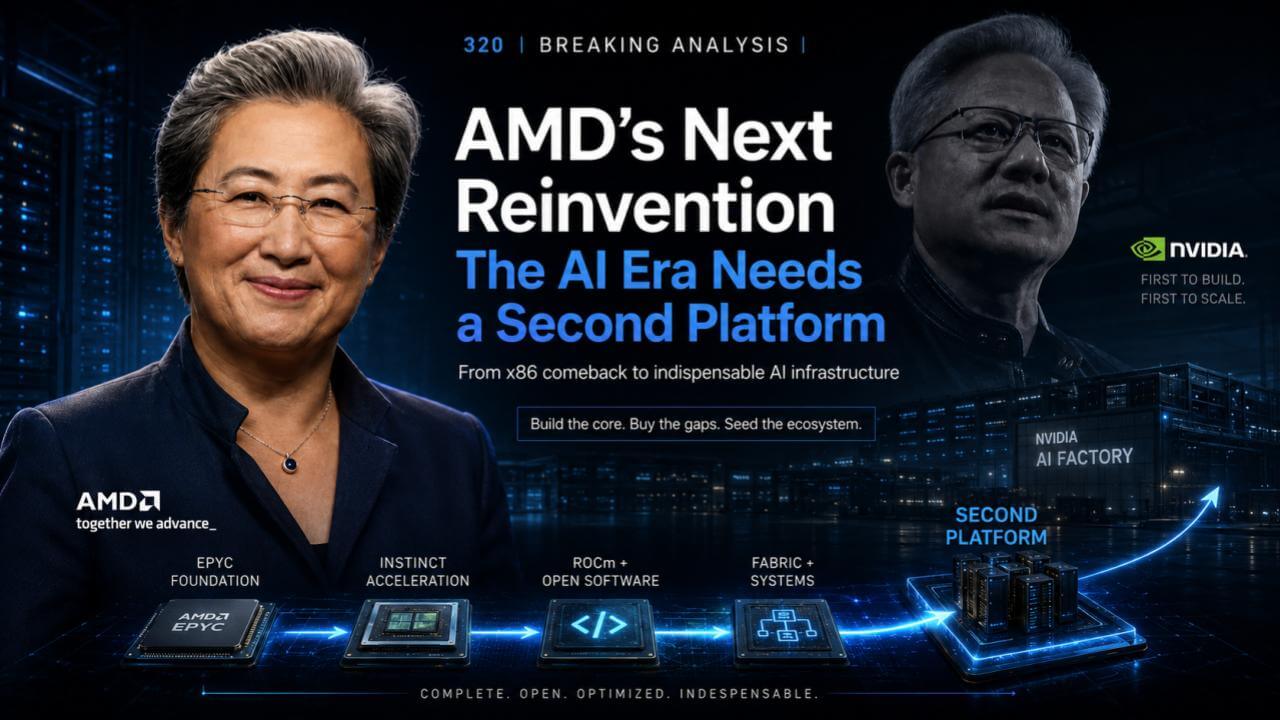
AMD is trying to reposition itself for the AI infrastructure market as the most credible alternative to Nvidia, according to a new analysis by SiliconANGLE’s Dave Vellante. The argument matters because AMD’s prior comeback came from CPUs and Intel’s execution problems, while the AI systems market is being shaped by full-stack platforms, not stand-alone chips.
Vellante’s thesis is that AMD’s next phase will be built around EPYC server CPUs, Instinct accelerators, ROCm software, rack-scale systems such as Helios and a more open ecosystem. He does not argue that AMD is likely to unseat Nvidia, which he says should remain the leading AI infrastructure supplier for the foreseeable future.
That is a more sober benchmark than much of the AI hardware positioning in the market. AMD’s opportunity, in this reading, is to become the second platform large buyers can use to reduce supplier concentration, improve availability and put pressure on economics. The analysis did not cite new AMD revenue guidance or a specific AI revenue target.
From x86 recovery to AI platform building
AMD’s first reinvention followed several structural moves. The company spun out GlobalFoundries in 2009, shifting away from owning fabs and toward a design-led model that could use Taiwan Semiconductor Manufacturing Co.’s manufacturing scale. It then rebuilt its CPU roadmap around Zen, with Jim Keller returning to help shape the architecture and Mike Clark leading CPU microarchitecture work, according to Vellante.
Lisa Su, who became AMD’s chief executive in 2014 at age 44, turned that technical reset into a product cadence across Ryzen in PCs and EPYC in the data center. SiliconANGLE credits that consistency with restoring confidence among customers, partners and investors.
The result was share recovery against Intel. Vellante says AMD now has roughly 55% revenue share in the x86 data center market. He also frames Intel’s weakness as a timing problem: x86 unit volumes peaked around 365 million circa 2011, while Arm-based volumes grew into the billions, giving TSMC cost advantages as Arm became the high-volume architecture.
That backdrop is different from AI infrastructure. Nvidia’s advantage is not limited to GPUs, according to the analysis. It includes CUDA, developer adoption, networking assets from Mellanox, NVLink, Spectrum-X, rack-scale system work and nearly two decades of ecosystem development.
Buying missing pieces
AMD’s response has included acquisitions aimed at gaps in an AI platform strategy. Vellante points to Xilinx, which brought FPGA and adaptive computing assets, as the largest part of what Su described at an investor day as $60 billion in acquisitions. About $49 billion of that total was Xilinx. Pensando added data processing units and networking expertise, while ZT Systems gives AMD rack-scale integration capability.
The analysis presents those deals as attempts to shorten the time needed to assemble a deployable AI stack. AMD still has to prove that EPYC, Instinct, ROCm, networking and rack systems can work as a coherent platform, rather than as strong parts sold into systems controlled by others.
Helios is described as a key integration test. If AMD can make the rack-level system, software and silicon story credible for hyperscalers and other large infrastructure buyers, it could claim a durable role in AI deployments. If not, the company risks remaining a component supplier in a market where Nvidia has set the terms around complete systems.
Intel also remains part of the context. Vellante notes Intel’s work under Chief Executive Lip-Bu Tan and its $5 billion Nvidia investment, including a planned dual-chip architecture for AI data centers. That gives AMD pressure from both sides: Nvidia at the platform layer and Intel as a recovering x86 competitor with a new AI-linked partner.
This story draws on original reporting from SiliconANGLE.