Xiaomi’s robot AI points to data scale over bigger models
Xiaomi says a 100,000-hour robotics dataset, collected mostly with handheld grippers, made its new model better at unfamiliar manipulation tasks.
By Colin Brandt · Enterprise Reporter
· 3 min read
Xiaomi has detailed Xiaomi-Robotics-1, a robot AI model trained on more than 100,000 hours of motion data, and says the work shows data volume matters more than model size for physical manipulation. The company did not disclose revenue impact, commercial terms or any customer deployments, but it plans to release the model and code on GitHub and Hugging Face.
The release is aimed at a hard constraint in robotics: useful movement data is scarce, expensive and often repetitive. Large language models can consume internet-scale text, while robots usually need people to teleoperate hardware through specific tasks, in specific rooms, with specific objects. Xiaomi’s approach replaces much of that collection process with a cheaper capture setup.
Handheld grippers stand in for robots
Xiaomi collected most of its pretraining data with portable handheld grippers fitted with cameras. A person can carry and operate the gripper directly, recording manipulation actions in homes, offices, shops, restaurants, industrial sites and outdoor spaces without deploying a robot.
The resulting dataset covers about 100,000 hours, more than 1,700 environments, 2.4 million episodes and over 260 tasks, according to Xiaomi. Because manually labeling that much footage would be slow, the company used another AI model to generate text descriptions for motion segments. Xiaomi says the full labeling run took about two weeks.
The company then adapted the model to real robots, including wheeled systems and dual-arm machines, using a mix of its own robot recordings from apartments, open-source robot datasets and annotated handheld-gripper data. That transfer still leaves a technical gap: a human-held gripper does not move like a robot arm, and Xiaomi’s results should be read with that limitation in mind.
Data scaling beats parameter scaling in Xiaomi’s tests
Xiaomi says larger models helped, but adding training data produced bigger gains than adding compute. In pretraining tests comparing data volume with model size, including models shown up to 10 billion parameters, more data reduced prediction errors more effectively. With limited data, Xiaomi’s charts show performance eventually worsening later in training.
The same pattern appeared on physical robots, according to the company. As Xiaomi increased the amount of pretraining data, success rates in unfamiliar environments rose from about 25% to 75%. The researchers said they have not yet found a point where additional data stops improving results.
Xiaomi also claims Xiaomi-Robotics-1 achieved the best reported results across standard robot AI benchmarks. On RoboCasa365, the model scored 57.4 points, ahead of ABot-M0.6 at 46.6 and ABot-M0.5 at 40.3. On RoboDojo, Xiaomi says its system scored about 58% higher than the runner-up, although the absolute success rates remain low.
Fast adaptation remains the commercial test
For robotics operators, the more relevant claim is adaptation. Xiaomi tested the model on four new tasks: packaging a phone, loading laundry into a washing machine, feeding paper into a printer and packing items into a box. With less than 10 hours of training data per task, Xiaomi says the model averaged a 75% success rate. A model from Physical Intelligence reached 40% in the same test, according to Xiaomi.
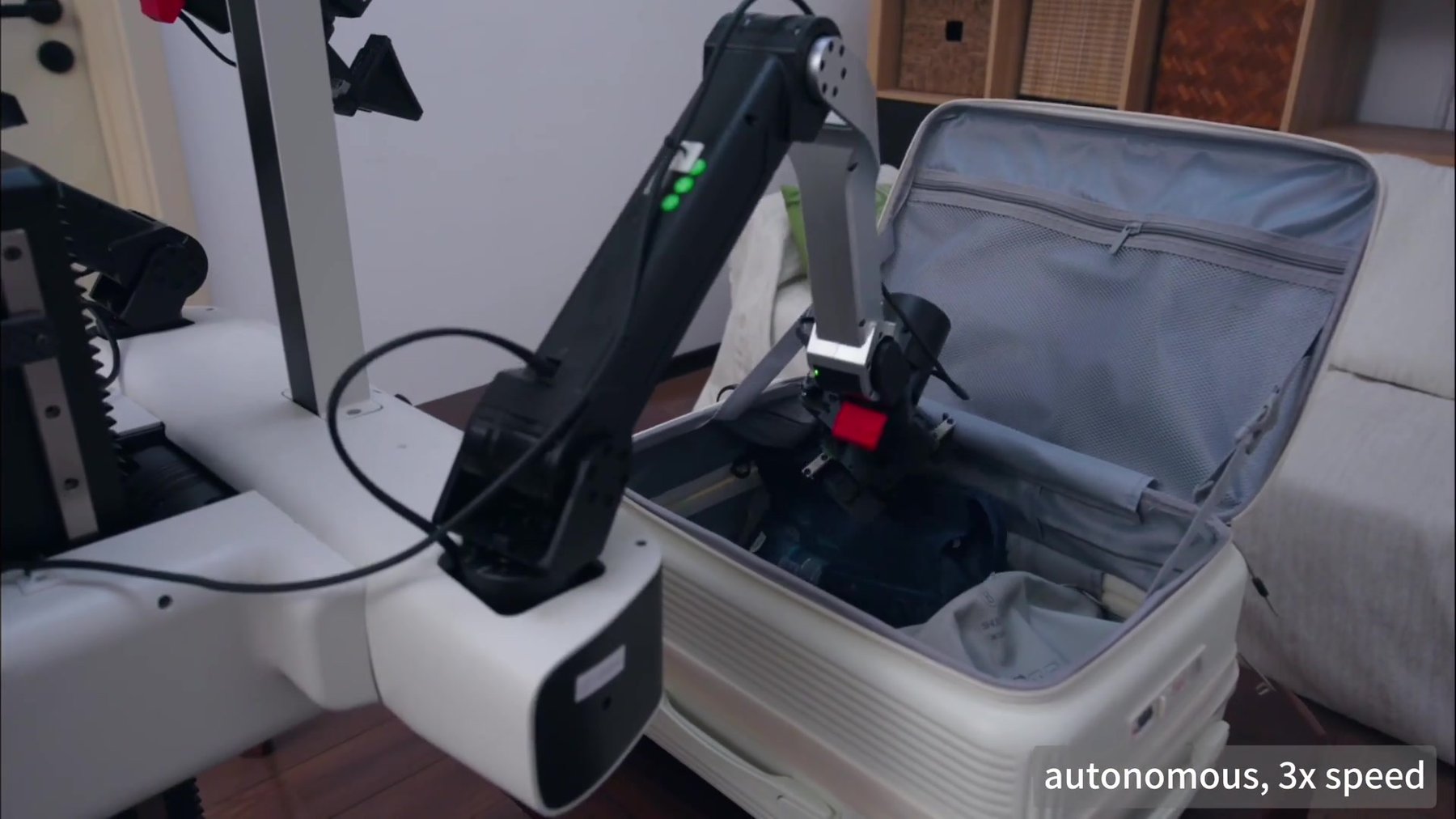
The company said Xiaomi-Robotics-1 performed well on soft or deformable objects such as paper and on tasks requiring movement across a room. In one demo described by Xiaomi, a robot packed a suitcase without human help, taking more than 10 minutes and moving around the room.
The work sits among several competing approaches to robotics data. Nvidia, Carnegie Mellon University and UC Berkeley have used AI coding agents to teach a fleet of eight robots to grasp objects. Nvidia has also pushed synthetic data as a way to turn robotics data collection into a compute problem. China’s BAAI has taken a different route with Orca, a world model trained on 125,000 hours of video without action labels.
Xiaomi’s bet is more direct: collect varied real-world manipulation data cheaply, label it automatically and scale it. The open release, if it arrives as promised, will give robotics teams a chance to test whether those benchmark gains hold outside Xiaomi’s evaluation setup.
This story draws on original reporting from The Decoder.