Alibaba ships Qwen-Image-3.0 for text-heavy AI image generation
The new Qwen model targets infographics, mockups and document-like images, with invite-only API access and no disclosed pricing.
By Renata Fuchs · Policy Reporter
· 3 min read
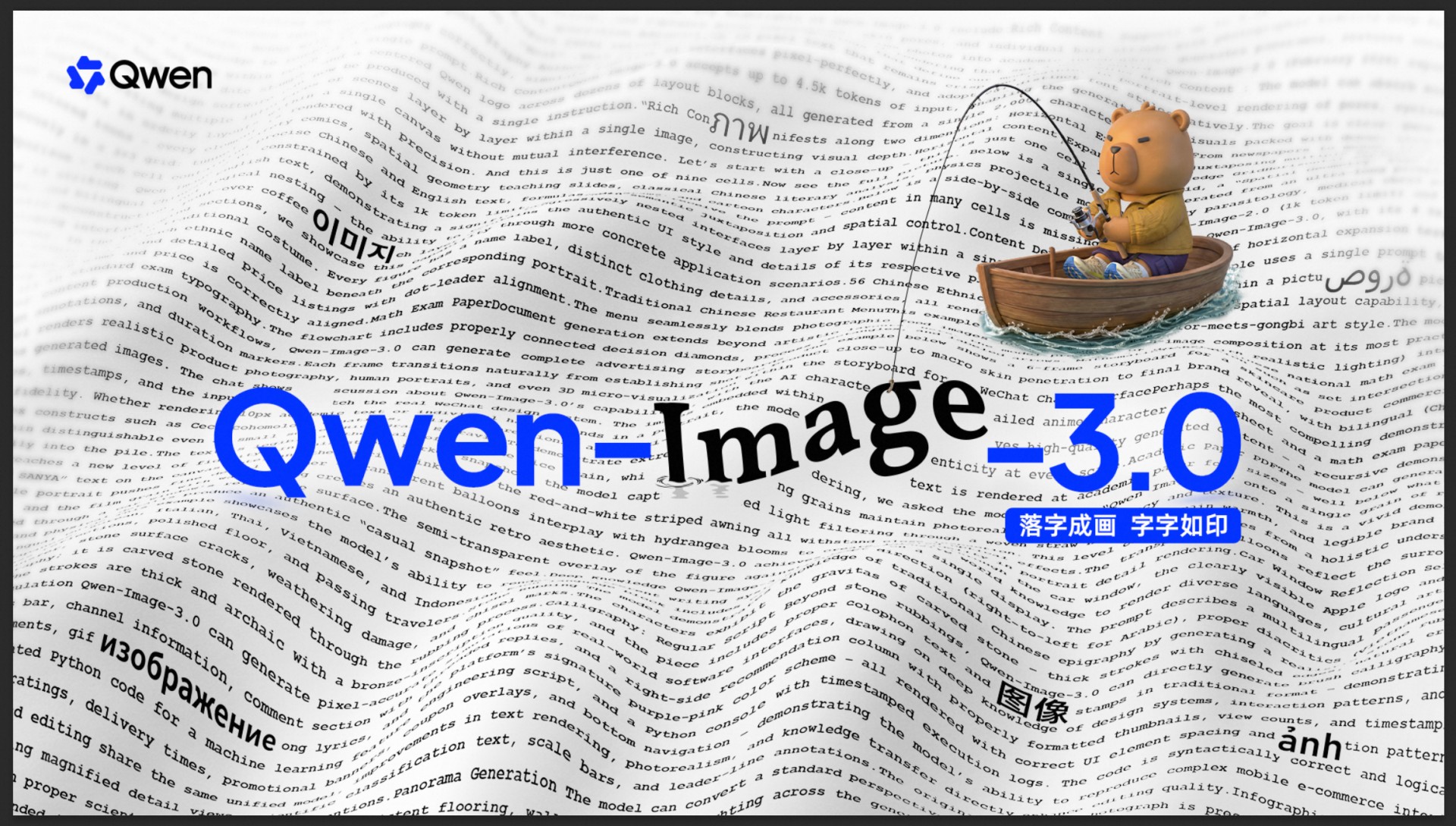
Alibaba’s Qwen team has released Qwen-Image-3.0, a new image-generation model aimed at dense visual work such as infographics, newspaper-style pages, exam sheets and software mockups. Pricing was not disclosed, and access is currently limited to an invite-only API, which keeps the launch closer to a controlled rollout than a broad developer release.
The pitch is less about prettier AI art and more about whether image models can reliably place information inside a frame. According to Qwen, the model can take prompts up to 4,500 tokens and produce complex layouts from a single generation, including small text, formulas, diagrams and multiple panels.
Alibaba is pushing on layout, not just image quality
Qwen’s published examples show a nine-panel grid containing separate educational and technical infographics. The panels cover subjects including tunnel safety, geometry, Confucian thought, physics, liver flukes, right-sided chest pain, Sylow theorems, bank internal controls and cell biology. Each panel combines labels, illustrations and explanatory text inside one composite image.
Another example stacks several interfaces inside one image: a VSCode window, a Qwen Chat screen, a WeChat conversation and a coffee-brewing poster. The demo is designed to show that the model can manage nested UI structures, rather than only isolated objects or single-scene images.
Qwen says Qwen-Image-3.0 can render legible text down to 10 pixels. Its examples include a whale shark infographic, a simulated newspaper page and a fictional academic paper page with LaTeX-style math, including subscripts, superscripts, braces, fractions, sums and products. The company also showed red handwritten-style annotations resembling teacher feedback.
Multilingual support and editing are part of the release
The model supports 12 languages natively, according to Qwen, including Japanese, Korean and Spanish. The company also showed examples of website, game and livestream-style interface generation.
For editing, Qwen showed the model turning an insect photo into an identification plate with taxonomy, labeled body parts, magnified detail views and a scale bar. Another demo repairs a damaged traditional ink painting of fighting eagles, filling missing sections while matching the surrounding brushwork and ink shading, according to Qwen.
Qwen also claims the model can use live internet data, with one example generating a weather forecast for Hangzhou. The company did not provide broader details in the described materials about latency, pricing, rate limits, safety controls or enterprise deployment terms.
The release follows a fast iteration cycle
Alibaba released Qwen-Image-2.0 in May. That version focused on training and inference efficiency, including a faster variant that generated images in four steps rather than 40. In Alibaba’s own arena tests, Qwen-Image-2.0 ranked behind OpenAI’s GPT-Image-2 and Google’s Nano Banana Pro, according to the prior reporting cited around the release.
Qwen-Image-3.0 is expected to appear in Alibaba’s own products, including Qwen Chat. Unlike the original Qwen-Image model, whose weights were released under an open license, this version appears unlikely to receive the same treatment based on the current rollout.
The useful part of the release is the progress on text and layout, two areas where image models have often failed in production settings. The less settled part is workflow fit. Researchers, publishers and designers usually need editable, searchable files rather than flat generated images. Qwen-Image-3.0 may be more relevant for drafts, prototypes, thumbnails and synthetic visual assets than for final production documents, unless Alibaba pairs the model with stronger editing and export tools.
This story draws on original reporting from The Decoder.