Visma puts 600-plus AI projects behind accounting automation
The European software group says its portfolio is using AI to automate bookkeeping, advisory and reconciliation, with Chaintrust and Dinero among the examples.
By Marcus Adeyemi · Startups Editor
· 3 min read
Visma says it now has more than 600 AI initiatives across its portfolio as it tries to automate more of the accounting, payroll and tax work handled by SMB software. The company did not disclose revenue, customer numbers, headcount, or the investment committed to the push, but its activity shows how incumbent software groups are applying AI to workflow automation.
The push sits in a hot category. Agentic AI startups in Europe raised €6bn last year and €4.6bn so far in 2026, according to Sifted data. In finance and accounting, named recent rounds include Spanish treasury management startup Embat’s €30m raise in May and Milan-based JetHR’s €25m round in June.
How Visma says it evaluates AI inside its portfolio
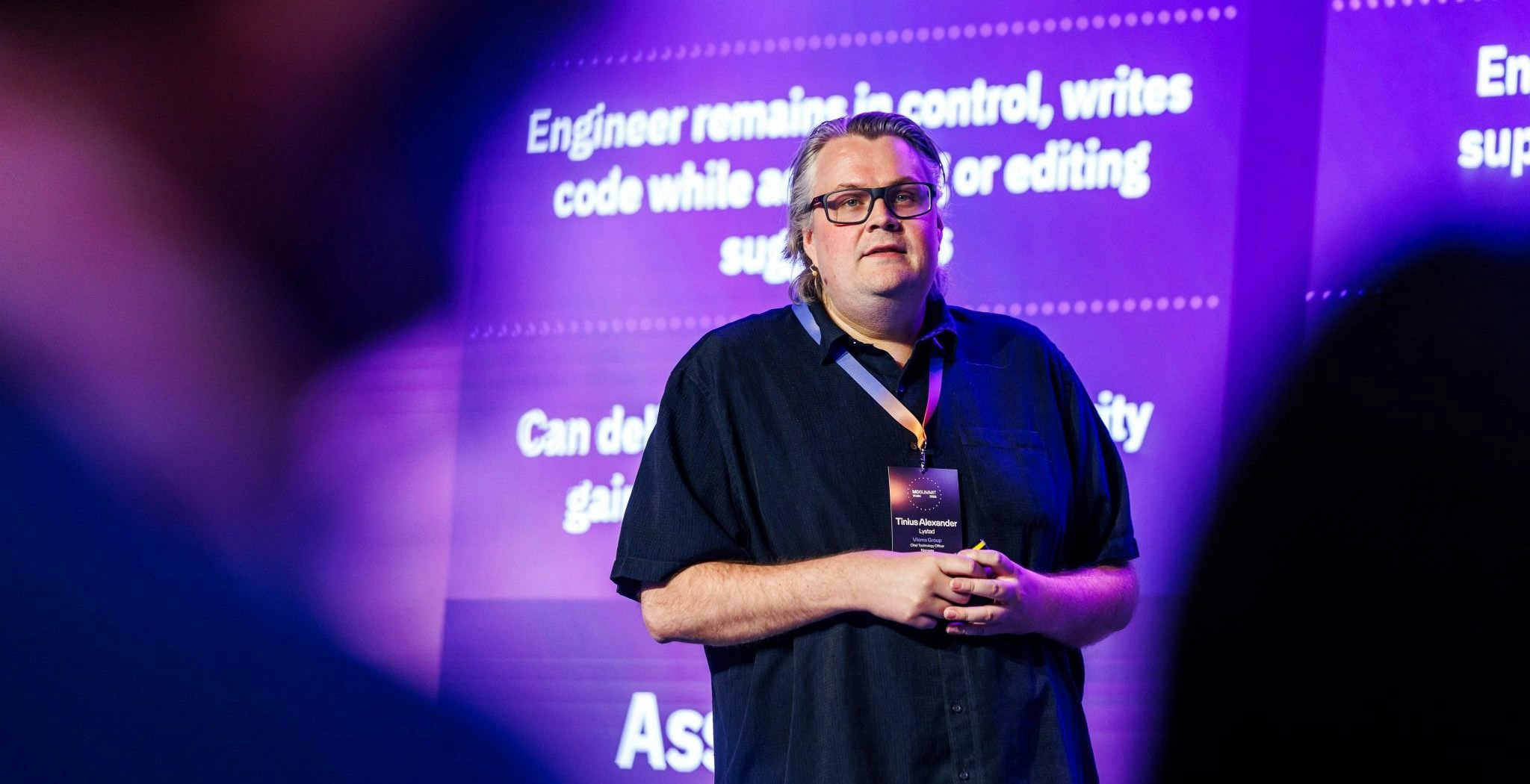
Visma sells SMB software for accounting, payroll and tax, and owns accounting software companies across Europe. CTO T. Alexander Lystad said the group separates AI work into early experiments and projects that could be rolled out across more of the group.
For acquisitions, Lystad said Visma does not require targets to be profitable. It looks for evidence that customers use the product, including adoption, frequency of use and feedback, as well as software adapted to local markets. Terms and valuations for relevant portfolio companies were not disclosed.
Lystad described four types of AI value Visma looks for: automating tasks such as data extraction, booking and bank reconciliation; assurance work such as anomaly detection in payroll; advisory functions that surface patterns from data; and agentic systems that can complete broader workflows.
Chaintrust and Dinero use AI in accounting workflows
Chaintrust, a Visma company led by Mikael Gandon, uses AI to scan, extract, review and post entries such as invoices and receipts into the relevant accounts. Gandon said manual invoice entry has been a persistent time sink for accounting staff, with junior employees spending substantial time reading supplier invoices, identifying ledger accounts and entering data into production software.
Gandon said general-purpose AI tools such as ChatGPT often lack the accounting context needed in regulated finance. He also said automation does not mean accounting roles disappear, arguing that firms can expand client portfolios without headcount rising at the same pace while staff spend more time reviewing work and advising clients.
Dinero, another Visma company, is developing a virtual CFO feature for small businesses. Managing director Martin Thorborg said the feature connects to a company bank account through open banking, handles routine bookkeeping and payments, and lets business leaders ask questions about their data.
Dinero says the feature is being developed to predict whether invoices will be paid on time, identify reliance on a single customer or supplier, and compare a company’s goals with data from similar markets. The company did not disclose usage figures for the feature.
Accuracy remains the constraint
Thorborg said Dinero uses generative models for advisory features and machine learning or other algorithms for core accounting workflows, where wrong entries can create compliance and legal exposure. He said Dinero runs around 20k tests each time it ships an update.
Visma and its portfolio companies track AI performance through efficiency and longer-term customer usage, according to the company. Gandon said automation rate is the central metric, with the focus on how many entries move through the system without human intervention, rather than lab accuracy claims.
Lystad said he expects AI to become a standard part of software products over time. In accounting, the benchmark will be practical: fewer manually touched entries, fewer errors and less closing work. Visma’s examples point to a portfolio-level effort to move from data capture toward workflow execution, while Gandon said human accountants remain responsible for judgment, tax interpretation and difficult client conversations.
This story draws on original reporting from Sifted.