RAISE Summit speakers frame agentic AI as an infrastructure problem
Executives at RAISE Summit said inference workloads are forcing changes in chips, storage, financing and data control, with few hard adoption metrics disclosed.
By Dominic Okoye · Staff Writer
· 3 min read
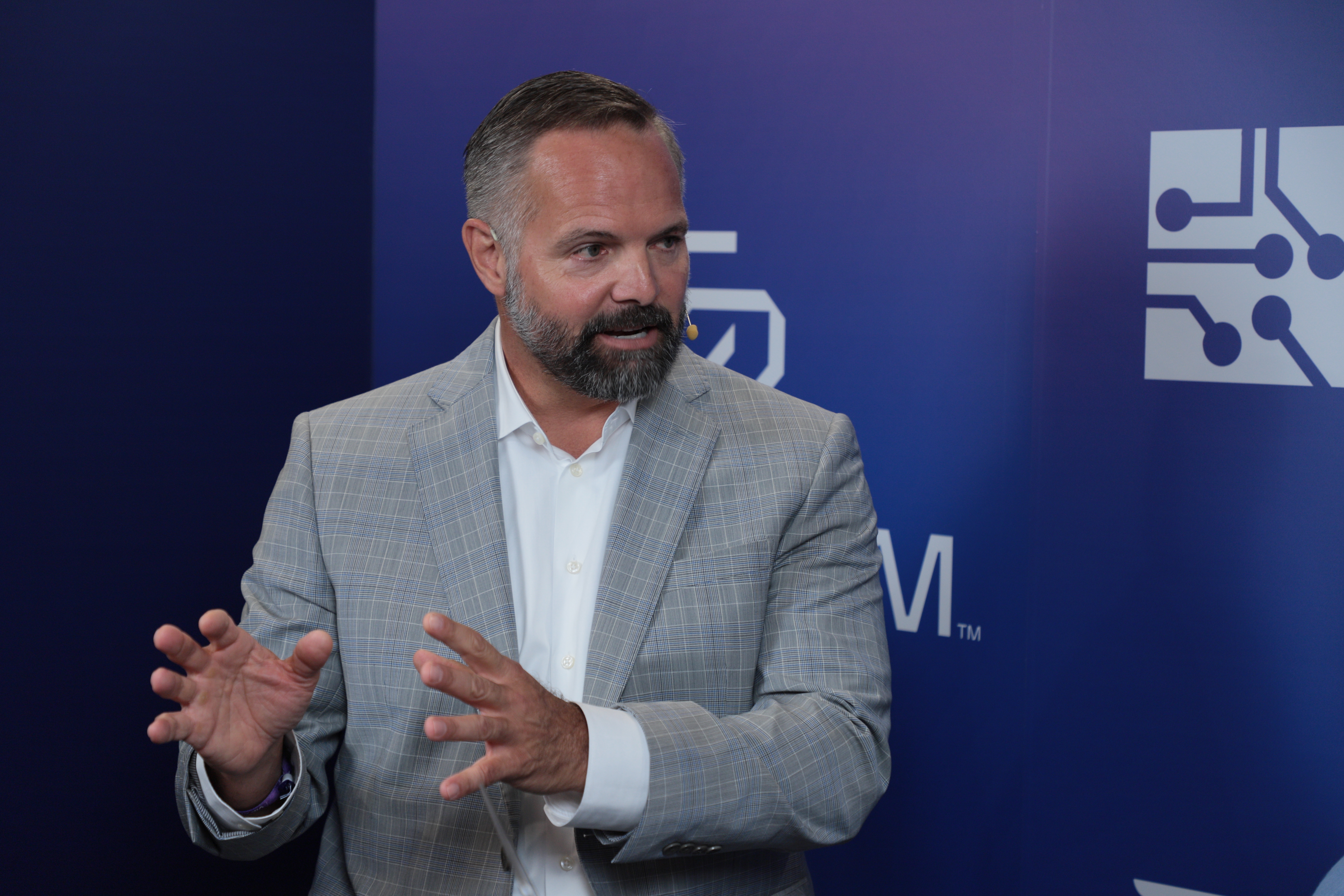
AI infrastructure vendors at RAISE Summit argued that agentic inference is shifting spending pressure from model training alone to the full systems that feed, run and govern enterprise AI. The discussions did not disclose financing rounds, valuations or broad customer counts, but they did show where suppliers are trying to attach themselves to the next phase of AI buildout: accelerators, storage, capital structures and data sovereignty.
Greg Matson, senior vice president and head of marketing and products at Solidigm, told SiliconANGLE’s theCUBE that storage is becoming a new tier used to extend system memory as inference workloads move toward longer context windows and memory-assisted reasoning. His argument is straightforward: expensive GPUs lose economic value when they wait for data, so storage placed close to accelerators becomes part of performance rather than back-office capacity.
That position is convenient for Solidigm, a storage vendor and a trademark of SK Hynix NAND Product Solutions Corp., but it lines up with a broader problem in AI systems design. Agent-style applications can require repeated retrieval, longer sessions and more state than older prompt-response deployments. If that context does not fit in accelerator memory, infrastructure teams have to decide where it lives and how quickly it can be retrieved.
Compute suppliers pitch specialization
Mark Papermaster, chief technology officer and executive vice president at Advanced Micro Devices Inc., said AMD is optimizing across CPUs, GPUs, adaptive computing and networking rather than treating AI as a single-chip problem. According to Papermaster, AMD’s ROCm software is meant to provide a common layer across large data center clusters, edge deployments and AI PCs.
Other companies at the event pushed more specialized approaches. Gilles Backhus, co-founder of Tensordyne Inc., said the company’s Napier inference chip uses a proprietary logarithmic number system that substitutes additions for multiplications to reduce the need for power-hungry multiplier circuits. Backhus said a 72-chip Napier pod consumes 30 kilowatts, compared with 150 kilowatts for what he described as a comparable Nvidia Corp. system. The claim was not accompanied by independent benchmark detail in the event coverage.
d-Matrix Corp. co-founders Sudeep Bhoja and Sid Sheth pointed to a Parasail deployment that combines d-Matrix Corsair accelerators with Nvidia Hopper and Blackwell GPUs. Their view is that inference can be split between compute-heavy prefill work and latency-sensitive token generation, a heterogeneous design intended to reduce response delays in longer-running agent workloads.
Storage vendors move closer to workloads
Solidigm is also trying to reframe SSD evaluation around live AI workloads. Avi Shetty, the company’s vice president of AI ecosystem, solutions and market enablement, said buyers care less about isolated random read and write specifications than about how storage behaves inside an AI data center. Solidigm’s AI Central Lab tests workloads across accelerator hardware and partner software, according to the company.
The practical message for operators is that AI infrastructure procurement is becoming less modular. A storage decision can affect token throughput, a networking bottleneck can affect GPU utilization and a software stack can determine whether specialized accelerators are usable outside a lab.
Financing and sovereignty enter the architecture debate
Andrew Sobko, founder and chief executive of Argentum AI Inc., said the company uses a demand-first model that lines up customers before committing capital to projects. He described financing speed as a deployment constraint and said Argentum aims to combine power, compute and capital while staying neutral on silicon and OEM choices.
Data control was another recurring theme. Amit Eyal Govrin, chief executive of Agentcy Labs Inc., and Philip Rathle, chief technology officer of Neo4j Inc., said enterprise AI sovereignty now includes territory, operations, the technology stack, legal exposure and unit economics. Rathle said knowledge graphs can give companies deterministic business rules and governance alongside large language models.
TheCUBE disclosed that it was a paid media partner for RAISE Summit and that Solidigm sponsored its event coverage. It said sponsors did not have editorial control over SiliconANGLE or theCUBE content.
This story draws on original reporting from SiliconANGLE.