OpenAI launches Presence for enterprise agent development
Presence gives companies tools to build, test and monitor narrow-task AI agents, with early access limited to a small group of enterprises.
By Colin Brandt · Enterprise Reporter
· 3 min read
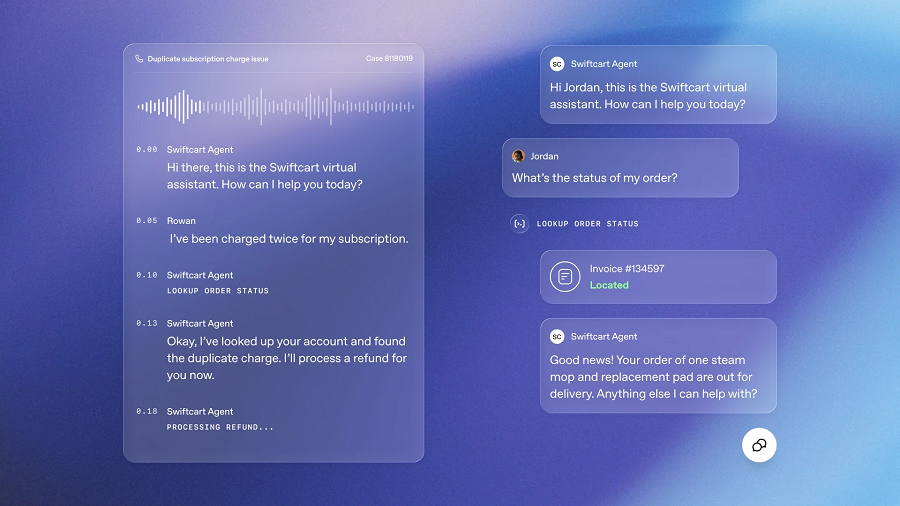
OpenAI Group PBC has introduced Presence, enterprise software for building AI agents, and is already using it in its own support operation. The company did not disclose pricing, revenue expectations or how many customers will get access at launch, but said the product is available through a limited general availability program for a small group of enterprises.
Presence is aimed at companies that want agents for constrained business workflows rather than broad, open-ended automation. OpenAI gave examples including supplier onboarding for procurement teams and lead-data collection for sales organizations. That positioning puts the product in the crowded enterprise agent market, where buyers are asking vendors to show reliability, permissioning and measurable output quality rather than another broad claim about AI productivity.
OpenAI said Presence is handling about 75% of inbound support requests for ChatGPT and that, within several weeks of deployment, it reached response quality comparable to the company’s help desk representatives. The company did not provide underlying support volume, evaluation methodology or error-rate data, so the benchmark is difficult to assess from the outside.
Guardrails and simulation are the main pitch
The product includes controls for limiting what agents can do and which systems they can use. In one example described by OpenAI, a retailer could restrict an agent to specific product databases when answering sales questions. Presence can also define how an agent interacts with systems it is permitted to access, a key issue for enterprises that need to connect AI tools to internal applications without giving them unchecked authority.
Developers also get a simulation feature for stress-testing those controls before agents are deployed. Presence generates uncommon or edge-case requests and evaluates how agents respond. It also checks whether an agent selects the appropriate tools while processing prompts, according to OpenAI.
Once an agent is live, Presence uses Codex, OpenAI’s programming assistant, to track output quality. OpenAI said the monitoring system collects signals such as how often an agent escalates difficult requests to a human support worker, then turns that data into recommendations for improving the agent.
The telemetry has a second use beyond tuning the agent itself. OpenAI said a software company, for example, could review support-agent data to identify recurring technical problems reported by users, then use that information to prioritize product fixes.
Built on newer OpenAI models
Codex runs on GPT-5.6, the model family OpenAI introduced last month. OpenAI said the top model in that family, called Sol, set a record on OSWorld, a benchmark focused on multi-step knowledge-work tasks. Those are the kinds of tasks Presence is being sold to automate, although benchmark performance does not by itself prove reliability inside a customer’s production systems.
OpenAI said launch customers will receive substantial technical help from its engineers. That support will cover connecting Presence-based agents to existing systems, setting guardrails and testing reliability. The need for hands-on implementation suggests Presence is still closer to a supported enterprise deployment than a self-serve platform.
The rollout follows another recent enterprise product from OpenAI, ChatGPT Work, an agent inside the ChatGPT application designed for business use. OpenAI said ChatGPT Work can use data from applications such as Excel to produce documents and automate more complex tasks that can take several hours. Presence extends that enterprise push from an application-level assistant into infrastructure for companies building their own agents.
This story draws on original reporting from SiliconANGLE.