Google adds Canva, Instacart and YouTube links to AI Mode
Google is giving AI Mode limited app connections as Search becomes a more transactional interface, starting with U.S. users.
By Wei-Lin Zhao · AI Correspondent
· 3 min read
Google LLC is adding app connections for Canva, Instacart and YouTube to AI Mode, its conversational AI interface inside Google Search. The update matters because Google is pushing Search beyond answers and summaries into lightweight task completion, an area where OpenAI Group PBC and Anthropic PBC have already moved with app integrations in ChatGPT and Claude.
Google announced the change in a company blog post and said the rollout starts in the U.S. The company did not disclose AI Mode usage, conversion metrics, commercial terms with the app partners or whether the integrations will be available to all users immediately.
AI Mode is separate from the standalone Gemini app, although it uses Gemini technology. It sits inside Google Search and is designed to respond to search queries with AI-generated summaries and follow-up answers based on web results. Since launching AI Mode in early 2025, Google has been adding features that make the product look less like a search results wrapper and more like an assistant layer across Google’s consumer services.
What the app links do
The initial integrations are narrow but practical. Google said a user planning a barbecue can ask AI Mode to generate a grocery list, connect an Instacart account, and place those items into an Instacart shopping cart. Payment still happens in Instacart’s app, according to Google’s example.
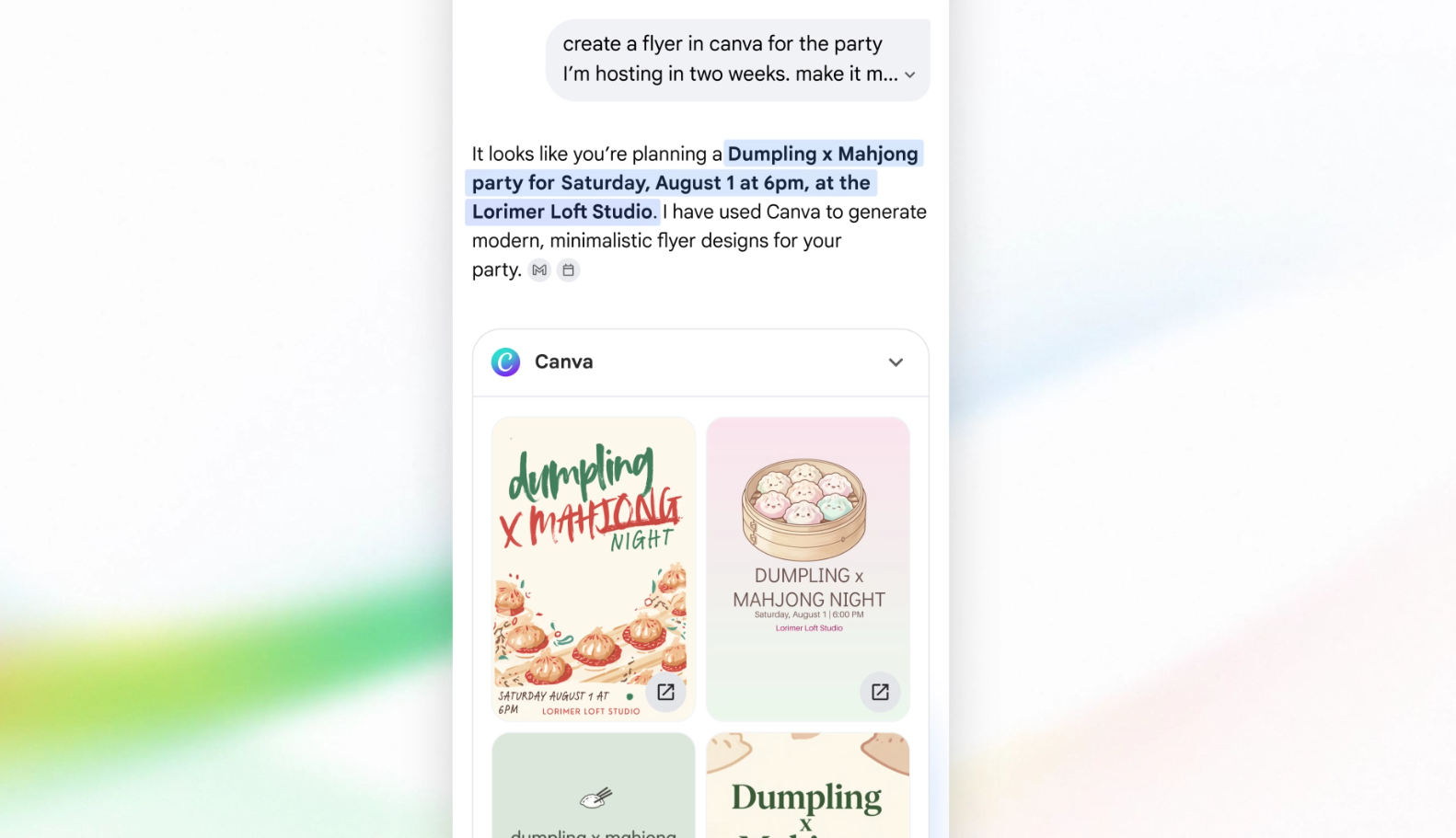
For Canva, Google said users can ask AI Mode for design help, such as finding flyer templates for a project. For YouTube Music, Google said users can ask AI Mode to build a playlist around preferred artists and save it to the music service.
The examples point to the pattern Google wants: Search captures intent, the AI layer structures the request, and the partner app handles the transaction or saved output. That is a smaller step than a fully autonomous agent, but it is a relevant one for product teams watching whether consumer AI assistants can generate repeat usage outside chat.
Google said more app support will be added in the coming weeks and months. It did not name the next apps or give a timetable beyond that.
Gemini already has a version of this
The feature also overlaps with work Google has already shown in Gemini. Earlier this year at Google I/O, Google launched similar app-connection capabilities for Gemini, including support for Canva, Instacart, OpenTable, Spark and other apps. Those Gemini integrations let the assistant complete tasks inside connected services.
That leaves Google running parallel AI surfaces: Gemini as the dedicated assistant product, and AI Mode as the Search-native interface. The distinction is useful for distribution. Search remains Google’s highest-traffic consumer product, while Gemini is where Google has concentrated much of its AI branding and feature rollout.
Google has also been broadening AI Mode with other commerce and personalization features. In a recent update, the company said AI Mode could check whether products are available at nearby stores. It also added a side-by-side browsing view so users can look at web pages while continuing to ask follow-up questions in AI Mode without dropping the original search context.
Another feature, called Personal Intelligence by Google, lets AI Mode search a user’s Gmail and Google Photos to produce more personalized responses. That raises the value of Google’s account data inside Search, while also increasing the amount of user information the product can draw on when answering queries.
The Canva, Instacart and YouTube links are not a platform shift by themselves. They show Google testing how much task execution belongs inside Search before users are handed off to another app.
This story draws on original reporting from SiliconANGLE.